Quick answer: An LED video wall is built from modular cabinets, so it can be scaled to large, custom sizes. An LCD video wall uses ready-made panels with a visible bezel line between screens. Before you choose, compare seams, brightness, lifespan, maintenance and the cost over several years, and check the viewing distance in the room.
Choosing a video wall for a control room, lobby, showroom or conference hall usually comes down to two technologies: an LCD video wall built from ready-made panels, or an LED video wall built from modular cabinets. Both show sharp images, but they differ in seams, brightness, lifespan, maintenance and the cost over several years. This guide compares LED video wall vs LCD video wall on the points that matter most in Pakistan, so you can decide which one fits your room. If your space is indoors and needs a large, modular display, our indoor LED video walls are one option to compare against any LCD quotation you receive.
What Is an LCD Video Wall?
An LCD video wall joins several flat LCD panels into one picture. Each panel has its own backlight and liquid crystal layer, and the panels are placed side by side with a frame, or bezel, around each one. Narrow-bezel models have bezels of around 0.9 mm, but a thin line still appears between panels. LCD walls are popular for control rooms and corporate lobbies because the panels are readily available and the image is very clear at close range.
What Is an LED Video Wall?
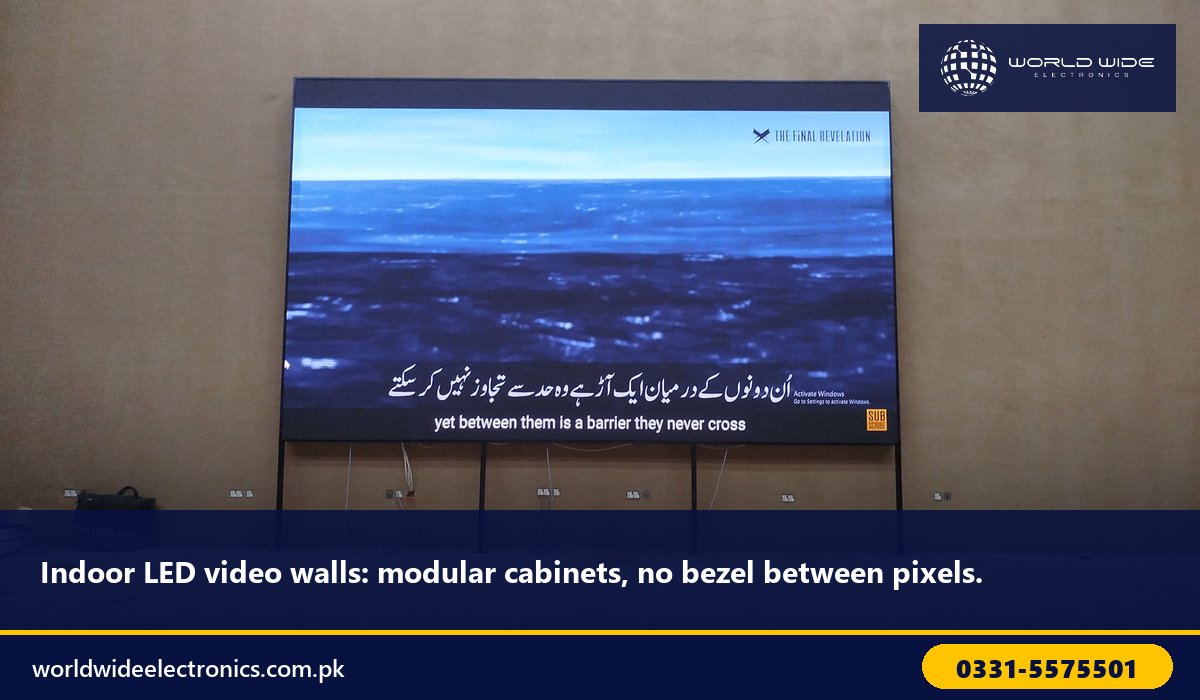
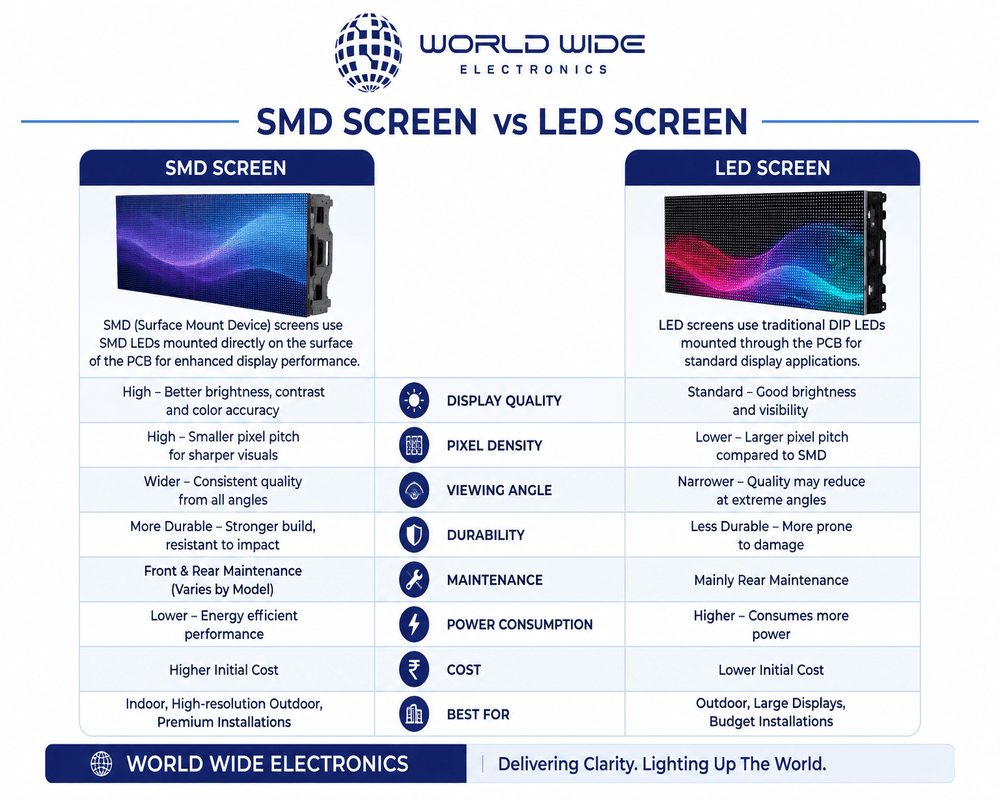
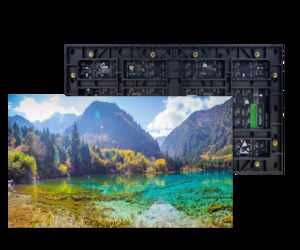
An LED video wall is built from modules or cabinets, each carrying a grid of SMD LEDs (surface-mounted diodes) that act as pixels. There is no backlight and no glass panel. The pixel density is set by the pixel pitch, and the cabinets are locked together in a grid to any size you need. Because the screen is made of modules, the wall can be curved, stepped or made taller or wider later. For a plain-language explanation of how these displays work, read our guide on the difference between an SMD screen and an LED screen.
Bezel Lines: The Most Visible Difference
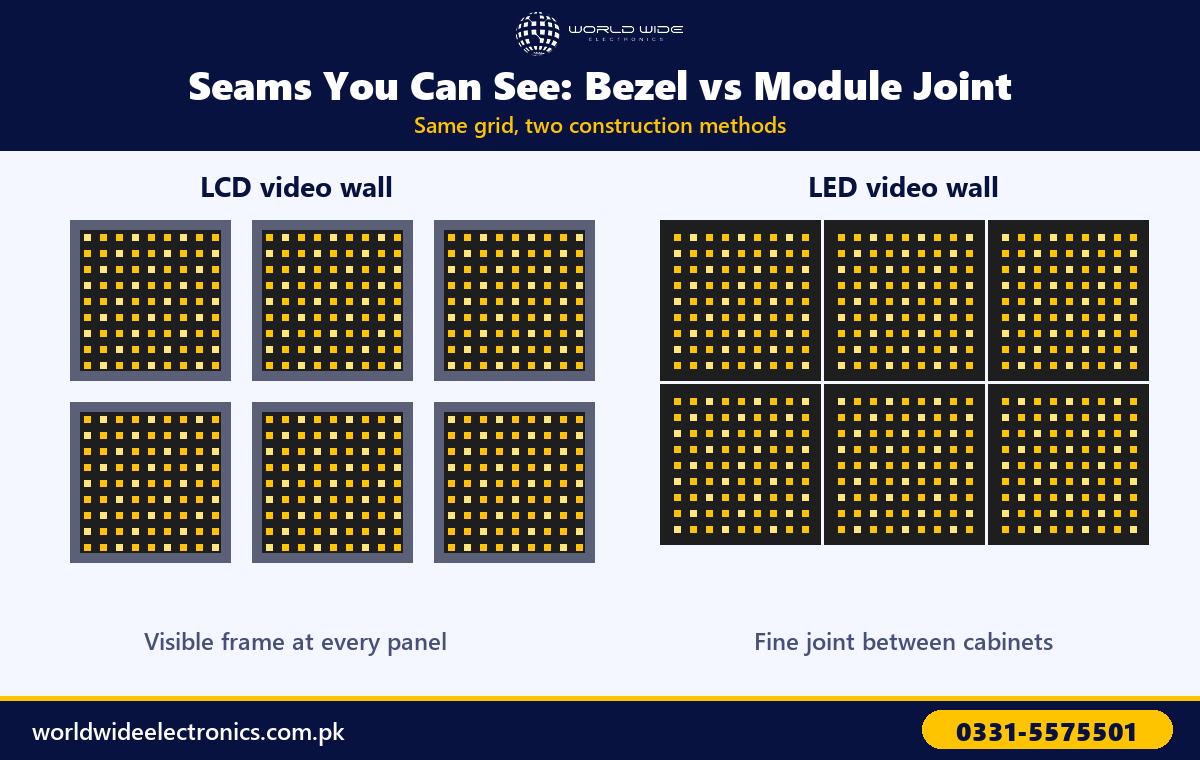
The bezel is the biggest visual difference between the two. On an LCD wall, every panel has a physical frame, so a thin dark line runs across the image at each joint. The line is small on a good panel, but it cuts through text, charts and moving graphics, and it becomes more noticeable as the wall gets bigger.
An LED video wall has no bezel between pixels. The joint between two cabinets is much finer than an LCD frame, and on a fine-pitch wall it is hard to see from normal viewing distance. Some LED walls still show a faint line at cabinet joints when the display shows a plain white or grey screen, so ask for a demonstration with a full-white test pattern before you buy.
Brightness Comparison
Brightness decides whether a screen can be read in a bright room or near a window. LCD panels are designed for offices and control rooms, where the lighting is controlled. Their brightness is usually lower than a high-brightness LED module, and the backlight slowly loses output over the life of the panel.
LED modules can be driven much brighter, which helps in rooms with large windows, lobbies with strong daylight, or events with stage lighting. You can also lower the brightness on an LED wall to save power and extend module life, which is not possible on a screen that is already at its limit. For more on matching brightness to your location, see our SMD screen sizes and pixel pitch guide.
Viewing Distance and Viewing Angle
Two other factors matter as much as brightness. The first is viewing distance. A common rule of thumb is that the closest comfortable viewing distance, in metres, is about the same as the pixel pitch in millimetres. So a P2 wall looks sharp from about 2 metres, while a P6 wall is better for viewers at 6 metres or more. LCD panels have a very fine pixel structure, so they look sharp up close, but they are not made in the large pixel pitches used for distant viewing.
The second is viewing angle. LCD panels can shift in colour and brightness when you look at them from the side, which matters in a conference room where people sit at the edges. LED walls keep a more consistent image across a wide angle, which is why they are common in meeting rooms and auditoriums. For a meeting-room layout in particular, read our guide to SMD LED screens for conference rooms.
Lifespan and Maintenance
Lifespan is where many buyers get surprised. An LCD panel is built around a backlight that dims over time, and when a panel fails, the whole panel is usually replaced. On a large wall, a single panel failure leaves a dead block of the image until the part arrives.
A quality SMD LED module typically runs for 80,000 to 100,000 hours at normal brightness. Its maintenance is different: a faulty module can be replaced individually from the front or rear, and a single cabinet can be swapped without taking the whole wall offline. The trade-off is that LED walls need calibration after repairs, and they need dust and humidity checks, especially outdoors or in dusty areas.
- LCD video wall: keep spare panels, check backlight output yearly, plan for panel replacement.
- LED video wall: keep spare modules, check power supplies and receiving cards, recalibrate after any module swap.
- Both: keep the room cool and dust-free, and use a licensed vendor for service.
Cost Over Time, Not Just the Purchase Price
The upfront cost of an LCD wall is often lower for small sizes, which is why LCD is common in offices with a 2 x 2 or 3 x 3 layout. The gap changes as the wall grows, and over several years the total cost can reverse. To compare fairly, add up the following for each option over the period you plan to use the screen:
- The purchase price, including the controller, mounting and installation.
- Power use at the brightness you will actually run.
- Expected replacement parts: panels for LCD, modules for LED.
- Calibration and servicing visits.
- Downtime cost while a faulty part is replaced.
Divide the total by the number of years of use, and you have a cost per year that you can compare directly. For current market ranges by screen type, see our SMD screen price guide.
LED Video Wall vs LCD Video Wall: Side-by-Side Comparison
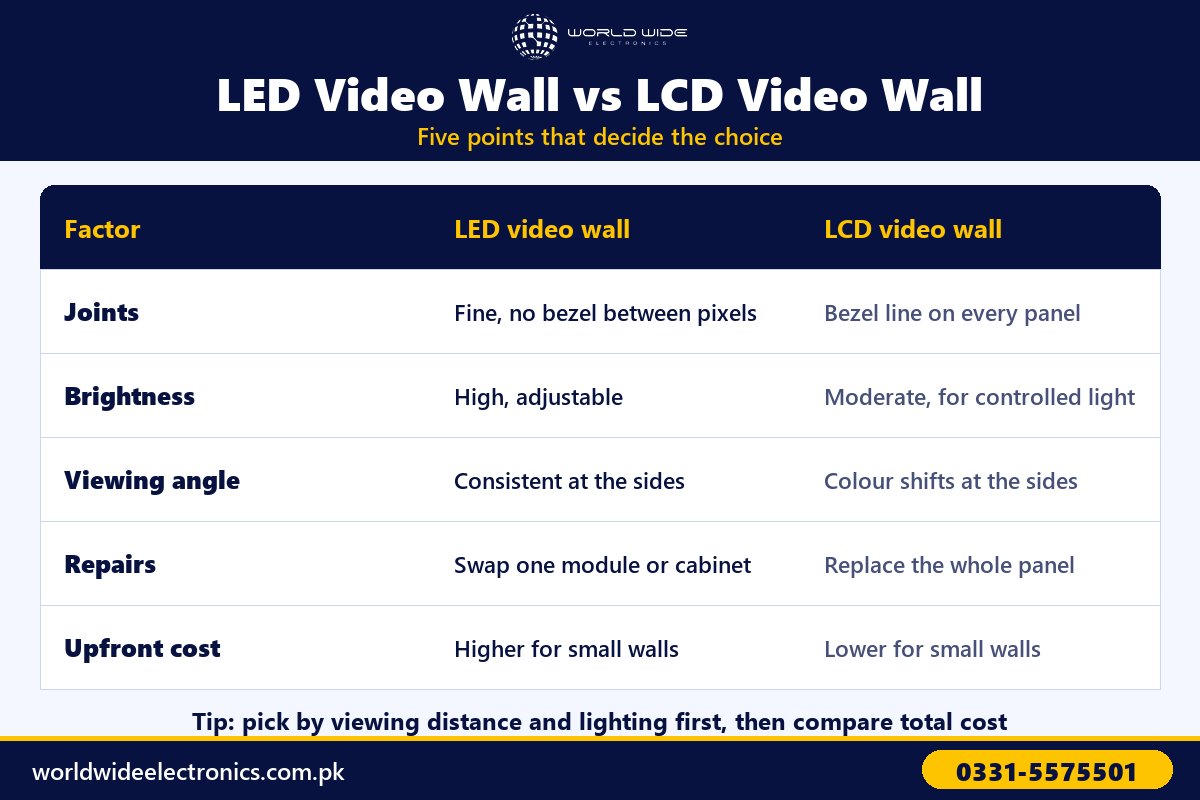
| Factor | LED video wall | LCD video wall |
|---|---|---|
| Joints between screens | Fine cabinet joints, no bezel between pixels | Visible bezel line at every panel |
| Brightness | High; can be adjusted up or down | Moderate; suited to controlled lighting |
| Viewing distance | Wide range by pixel pitch | Best up close |
| Viewing angle | Consistent across a wide angle | Colour and brightness shift at the sides |
| Size | Scales easily with more cabinets | Limited by panel size and frame count |
| Failure | Replace one module or cabinet | Replace the whole panel |
| Upfront cost, small wall | Usually higher | Usually lower |
| Cost over several years, large wall | Often competitive | Can rise with panel replacements |
When an LED Video Wall Is the Better Choice
An LED video wall is the stronger option when the wall is large, when people view it from different angles, when the room has daylight or strong lighting, or when you expect to add or move modules later. It is also the right choice for lobbies, showrooms, stage backdrops and any location where the wall doubles as an advertising or branding display.
When an LCD Video Wall Makes Sense
An LCD video wall suits a small, controlled room where people sit close to the screen and the lighting is consistent. A control room with 2 x 2 or 3 x 3 panels, a boardroom with a single large monitor, or a reception display used only during office hours are typical examples. If the wall will show mostly fixed dashboards or text, the bezel line matters less.
For a full control room layout, including the processor, power backup and 24/7 running, see our guide to control room video walls.
Buyer Checklist Before You Choose
- Measure the room, the wall space and the distance from the nearest and farthest seat.
- Decide the pixel pitch from the viewing distance, not from the lowest price.
- Ask for a full-white and a full-black test pattern on the actual units.
- Check the brightness rating and whether it can be lowered for night use.
- Ask about the warranty period, module or panel replacement policy and spare parts stock.
- Compare total cost over the years you plan to use the screen, not just the quotation.
- Confirm the controller, mounting and installation are included in the price.
Frequently Asked Questions
Is an LED video wall better than an LCD video wall?
Neither is better in every case. An LED video wall is usually better for large sizes, wide viewing angles, bright rooms and easy repairs. An LCD video wall is usually better for small, close-viewed setups with controlled lighting and a lower upfront budget.
Do LCD video walls have seams?
Yes. Each LCD panel has a bezel, so a line appears between panels. Narrow-bezel models reduce the line, but they do not remove it.
How long does an LED video wall last?
A quality SMD LED module typically runs for 80,000 to 100,000 hours at normal brightness. Actual life depends on how bright the wall is run, how hot the room is, and how well the cabinets are ventilated and kept clean.
Which is cheaper over five years?
For small walls, LCD is often cheaper at purchase. For large walls, the answer depends on power use, replacement parts and downtime. Compare the total cost over five years for each quotation, using the list above.
Get Help Choosing the Right Video Wall
World Wide Electronics has supplied and installed LED and display systems across Pakistan since 1999. Tell us the room size, the viewing distance, the lighting and how the wall will be used, and we will recommend the right technology and pixel pitch for that space. Contact us for a site survey and a comparison quotation. Schools that need a classroom display rather than a video wall can compare the options in our classroom display guide.