An SMD (Surface-Mounted Device) screen uses integrated RGB chips fused directly onto a panel, producing sharper images, wider viewing angles, and lower energy consumption. A traditional LED screen uses discrete diode clusters and excels in outdoor brightness. SMD screens are typically preferred for indoor commercial use, while conventional LED displays dominate large outdoor installations.
Choosing the Right Display Technology Matters
Every year, businesses across Pakistan and worldwide spend millions on display technology and many make the wrong choice simply because they don’t understand the difference between SMD screens and LED screens. The wrong investment can mean poor image quality, excessive power bills, or a display that simply doesn’t perform in your environment.
Whether you’re a retail store owner looking to grab foot traffic, a corporate office investing in a boardroom display, or a shopping mall upgrading its advertising screens this guide is written for you.
By the end of this article, you’ll know exactly which technology fits your space, budget, and audience and why that decision can directly impact your ROI.
What Is a Traditional LED Screen?
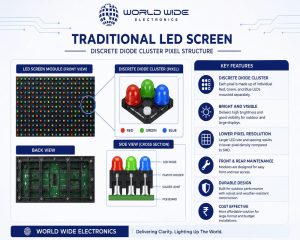
A Light Emitting Diode (LED) screen uses individual diodes tiny semiconductor devices that emit light when voltage is applied. In traditional LED configurations, separate red, green, and blue diodes are grouped in clusters to form each pixel.
These displays were revolutionary when first introduced. They offer exceptional brightness often exceeding 6,000 nits making them ideal for direct sunlight conditions. However, their pixel structure also means there are physical gaps between diode clusters, which limits resolution at close viewing distances.
Key Characteristics of Traditional LED Displays
- High brightness output (4,000–6,000+ nits)
- Larger pixel pitch (typically P6 to P16+)
- Designed predominantly for outdoor environments
- Robust and weather-resistant enclosures
- Lower resolution compared to SMD at same screen size
- Higher power consumption per square meter
What Is an SMD Screen?
An SMD (Surface-Mounted Device) screen is an advanced evolution of LED display technology. Rather than mounting individual red, green, and blue diodes in separate housings, SMD technology packages all three into a single, tiny, integrated chip that is soldered directly onto the circuit board’s surface.
This integration is what makes SMD screens produce significantly higher resolution, smoother colour blending, and wider viewing angles compared to their traditional counterparts. SMD technology is now the industry standard for high-quality indoor smd displays.
Key Characteristics of SMD Screens
- Integrated RGB chips in a single housing
- Pixel pitch as fine as P1.2 (indoor) or P2.5 (outdoor)
- Viewing angles up to 160° horizontal and vertical
- Energy-efficient — up to 40% less power consumption than traditional LED
- Lifespan of 80,000 to 100,000 hours
- Modular, lightweight panel design for easy installation
- Smooth, seamless image with no visible dot clusters
The Core Difference Between SMD Screen and LED Screen
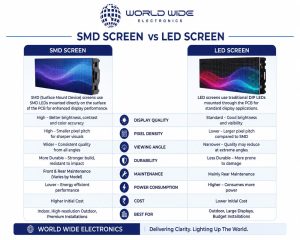
Now that we understand what each technology is, let’s break down the critical differences across every dimension that matters to a business decision-maker.
1. Pixel Structure & Resolution
Traditional LED: Uses three separate diodes per pixel (one red, one green, one blue), creating physical gaps between pixels. This limits minimum achievable pixel pitch.
SMD Screen: Fuses all three diodes into one integrated chip. This allows pixel pitches down to P1.2 mm, delivering ultra-high resolution even on smaller screen sizes.
For context: a 4m² SMD P2.5 screen contains approximately 640,000 pixels. An equivalent traditional LED P8 screen would have only 62,500 pixels roughly 10x fewer.
2. Viewing Angle
Traditional LED: Typically offers viewing angles of 90° to 100°. Viewers at the sides or sharp angles see a degraded, dimmer image.
SMD Screen: Achieves viewing angles of up to 160° both horizontally and vertically. This means consistent image quality for virtually every person in the room critical for retail floors, conference halls, and airport terminals.
3. Brightness and Outdoor Performance
Traditional LED: This is where conventional LED holds a significant advantage. Peak brightness of 5,000–8,000 nits makes traditional outdoor LED visible even in direct Pakistani summer sunlight.
SMD Screen (Outdoor): Modern outdoor SMD displays now achieve 4,000–6,000 nits, closing the gap considerably. Indoor SMD screens typically operate at 800–1,500 nits, which is more than sufficient for interior environments.
4. Energy Efficiency
Energy costs are a major operational consideration, especially for businesses running displays 12–18 hours per day.
SMD screens consume up to 40% less electricity than equivalent traditional LED displays. For a medium-sized retail display running 14 hours/day, this translates to substantial savings over a 3–5 year lifespan.
A typical 20m² SMD display might consume 3,200W versus 5,600W for a traditional LED equivalent saving approximately PKR 180,000–220,000 annually in electricity costs (based on commercial rates).
5. Installation & Flexibility
Traditional LED: Heavy steel cabinets, complex mounting systems, and significant structural requirements. Best suited for permanent, large-scale outdoor installations with professional engineering support.
SMD Screen: Lightweight modular panels that can be assembled quickly. Curved, irregular, and creative configurations are achievable. Rental SMD systems can be set up and dismantled in hours, making them ideal for events and exhibitions.
6. Lifespan & Maintenance
Traditional LED: Average lifespan of 50,000 hours. Individual diodes can be replaced, but the replacement process is labour-intensive.
SMD Screen: Premium SMD panels achieve 80,000–100,000 hours of operational life. Modular panel replacement is straightforward a technician can replace a faulty panel in minutes without disrupting the entire display.
SMD Screen vs LED Screen: Side-by-Side Comparison
The table below provides a quick reference for decision-makers comparing both technologies across the most critical parameters.
| Feature | Traditional LED | SMD Screen | Best Use |
| Pixel Pitch | 6mm – 16mm+ | P1.2 – P4 (indoor) | SMD for close range |
| Viewing Angle | 90° – 100° | Up to 160° | SMD for wide spaces |
| Brightness | 4,000 – 6,000 nits | 800 – 1,500 nits (in) | LED outdoor; SMD indoor |
| Energy Use | Higher | Up to 40% less | SMD for cost savings |
| Installation | Complex, bulky | Modular, flexible | SMD for ease |
| Lifespan | 50,000 hrs | 80,000–100,000 hrs | SMD for longevity |
| Best Environment | Outdoor/large venue | Indoor/high-res needs | Context-dependent |
| “The right display technology is not about which is newer — it is about which serves your specific environment, audience, and commercial goals.” |
Which Display Is Right for Your Business? Real-World Use Cases
Scenario 1: Retail Store Owner in Lahore
A clothing retailer on MM Alam Road wanted a display behind their checkout counter to run promotional content. They considered traditional LED but installed a P2.5 SMD screen instead.
Result: Crystal-clear product imagery visible from every angle in the store. Power consumption was 35% lower than the quoted traditional LED. Customers engaged significantly more with the dynamic display, and the store reported a measurable uplift in impulse purchases during promotional campaigns.
Recommendation: SMD screen (indoor P2 – P4)
Scenario 2: Shopping Mall Management in Karachi
A major shopping mall required both an outdoor billboard facing the main road and indoor way finding displays across multiple floors.
Solution: Outdoor billboard — traditional LED P8 for maximum sunlight visibility and durability. Indoor way finding and advertising panels — SMD P2.5 for clear, high-resolution imagery at 2–6 meter viewing distances.
Key Takeaway: Many large installations strategically combine both technologies based on environment.
Scenario 3: Corporate Office Boardroom
A multinational firm’s Islamabad head office needed a video wall for presentations, video conferencing, and data visualization.
Solution: SMD P1.5 LED video wall fine pixel pitch ensured text and data were razor-sharp even for executives seated 1.5 meters from the screen. The 140° viewing angle covered every seat in the boardroom.
Recommendation: SMD P1.2 – P1.8 for conference rooms and boardrooms
Scenario 4: Outdoor Billboard Advertising Agency
An advertising agency managing roadside billboards across highway networks needed maximum visibility over distances of 50–200 meters.
Solution: Traditional outdoor LED P10 – P16 displays. The high brightness, robust weatherproofing (IP65+), and wide pixel pitch are perfectly suited for long-distance, high-ambient-light environments.
Recommendation: Traditional outdoor LED (P8–P16) for highway and large outdoor applications
Understanding Pixel Pitch: A Critical Buying Factor
Pixel pitch refers to the distance in millimeters between the centers of two adjacent pixels. The lower the number, the higher the resolution and the closer viewers can stand without seeing individual pixels.
This is perhaps the most misunderstood specification in display purchasing decisions. Here is the practical rule:
- Minimum viewing distance (meters) ≈ Pixel pitch (mm) × 3 to 4
- 5 SMD = clear from as close as 1.5–2 meters
- P4 SMD = suitable from 4–6 meters
- P8 traditional LED = designed for 15+ meters
- P16 traditional LED = highway visibility at 30–80+ meters
For indoor commercial environments retail, corporate, hospitality SMD’s fine pixel pitch capability is decisive.
A Note on COB Technology: The Next Evolution
Chip-on-Board (COB) technology is an emerging advancement that places LED chips directly on the PCB substrate without individual packaging. COB displays offer even finer pixel pitches (P0.9 and below), improved durability, and virtually no individual pixel failure points.
For businesses considering future-proof investments in ultra-high-definition indoor displays, COB represents the next step beyond standard SMD technology.
How to Choose the Right Screen: A Step-by-Step Decision Framework
Use this practical framework before making your display investment:
- Define your environment: Is the screen indoor or outdoor? What is the ambient light level?
- Establish minimum viewing distance: How far will your furthest and closest viewers typically stand?
- Determine required brightness: Indoor environments rarely need more than 1,500 nits; outdoor installations in direct sunlight need 4,000+ nits.
- Calculate your content type: High-detail graphics, video, or text? SMD’s resolution advantage becomes critical for content-rich displays.
- Assess your installation constraints: Weight limits, power availability, and whether the installation is permanent or temporary?
- Compare total cost of ownership: Factor in purchase price, installation, energy costs, and maintenance over 5–10 years.
- Consult a certified display specialist: Specifications on paper don’t replace a site survey and expert recommendation.
“Total cost of ownership over 5 years — not the purchase price — is the metric that separates a profitable display investment from an expensive mistake.”
Pro Tips from Display Technology Experts
- Always request a live demo of the screen at its actual installation brightness before purchasing.
- For outdoor SMD screens, verify the IP rating — minimum IP65 for dust and rain protection in Pakistan’s climate.
- Insist on a 3-year minimum warranty with local service support. Imported display warranties without local servicing are effectively worthless.
- Consider calibration: High-quality SMD displays support colour calibration to ensure consistent imagery across multi-panel video walls.
- Energy audit first: Calculate your daily operating hours and compare the energy cost difference between SMD and traditional LED over 3 years.
- Ask about content management systems: Modern SMD screens come with cloud-based CMS, enabling remote content scheduling — a major operational advantage.
The Global LED Display Market: Why This Decision Matters Now
The global LED display market was valued at approximately USD 12.1 billion in 2023 and is projected to reach USD 28.7 billion by 2030, growing at a CAGR of 13.2%. SMD technology accounts for the fastest-growing segment within this market.
In Pakistan specifically, the commercial display market has seen rapid adoption — driven by retail modernisation, corporate communication needs, and outdoor advertising growth. Businesses that invest in the right technology now are securing a competitive advantage that compounds over time.
According to research published by Grand View Research (2024), fine-pixel-pitch LED displays predominantly SMD-based represented the highest-growth segment, driven by corporate AV, retail, and broadcast applications.
Frequently Asked Questions
Q: Is an SMD screen better than an LED screen?
A: For indoor applications, SMD screens are generally superior offering higher resolution, wider viewing angles, lower energy consumption, and longer lifespans. For large outdoor installations requiring maximum brightness, traditional LED may still be the practical choice, though outdoor SMD technology is rapidly closing the gap.
Q: What does SMD mean in LED screens?
A: SMD stands for Surface-Mounted Device. It refers to the manufacturing process where red, green, and blue LED chips are integrated into a single component and mounted directly onto the circuit board surface, resulting in smaller pixel pitches and improved image quality.
Q: What is the lifespan of an SMD screen vs a traditional LED screen?
A: Quality SMD screens typically achieve 80,000 to 100,000 hours of operational lifespan. Traditional LED displays commonly offer around 50,000 hours. Both figures can be significantly affected by operating temperature, brightness levels, and maintenance practices.
Q: Are SMD screens suitable for outdoor use?
A: Yes. Outdoor-rated SMD screens are available with IP65/IP66 weatherproofing and brightness levels of 4,000–6,000 nits, making them suitable for most Pakistani outdoor environments. Ensure the specific model is rated for outdoor use before purchasing.
Q: What pixel pitch should I choose for my business?
A: Choose pixel pitch based on your minimum viewing distance. As a general rule, multiply your pixel pitch in mm by 3–4 to get the minimum comfortable viewing distance in metres. For retail interiors (2–4m viewing), P1.5–P2.5 SMD is recommended. For outdoor billboards (15m+), P6–P10 is appropriate.
Q: How much does an SMD screen cost compared to a traditional LED screen?
A: SMD screens typically have a higher initial purchase cost due to their manufacturing complexity and tighter pixel pitch. However, when total cost of ownership is considered including energy savings, longer lifespan, and lower maintenance SMD screens frequently deliver a lower cost per year over a 5–10 year period.
Conclusion: Making the Right Display Investment
The difference between SMD screens and LED screens is not simply a matter of technology generations it is a matter of matching the right technology to the right environment, audience, and commercial objective.
SMD screens deliver superior resolution, wider viewing angles, longer operational lifespans, and meaningfully lower energy costs. They are the clear choice for indoor commercial environments, corporate spaces, retail displays, and any application where image quality at close-to-medium viewing distances is paramount.
Traditional LED displays retain their dominance in large-scale outdoor applications highway billboards, stadium screens, and large public space installations where raw brightness and long-distance visibility outweigh the need for fine resolution.
For most Pakistani businesses today retail, corporate, hospitality, and advertising SMD technology offers the most compelling total value proposition. And as outdoor SMD specifications continue to improve, the advantages of SMD are extending into the outdoor market as well.
Ready to Choose the Right Display for Your Business?
World Wide Electronics is Pakistan’s authorised distributor of Absen, Novastar, Qiangli display solutions. Our certified specialists provide free site consultations, live product demonstrations, and complete installation support.
Call us: +92 0331 5575501
Visit: https://worldwideelectronics.com.pk/
Offices in Karachi & Islamabad | Serving all of Pakistan