
What Is the Difference Between SMD Screen and LED Screen?
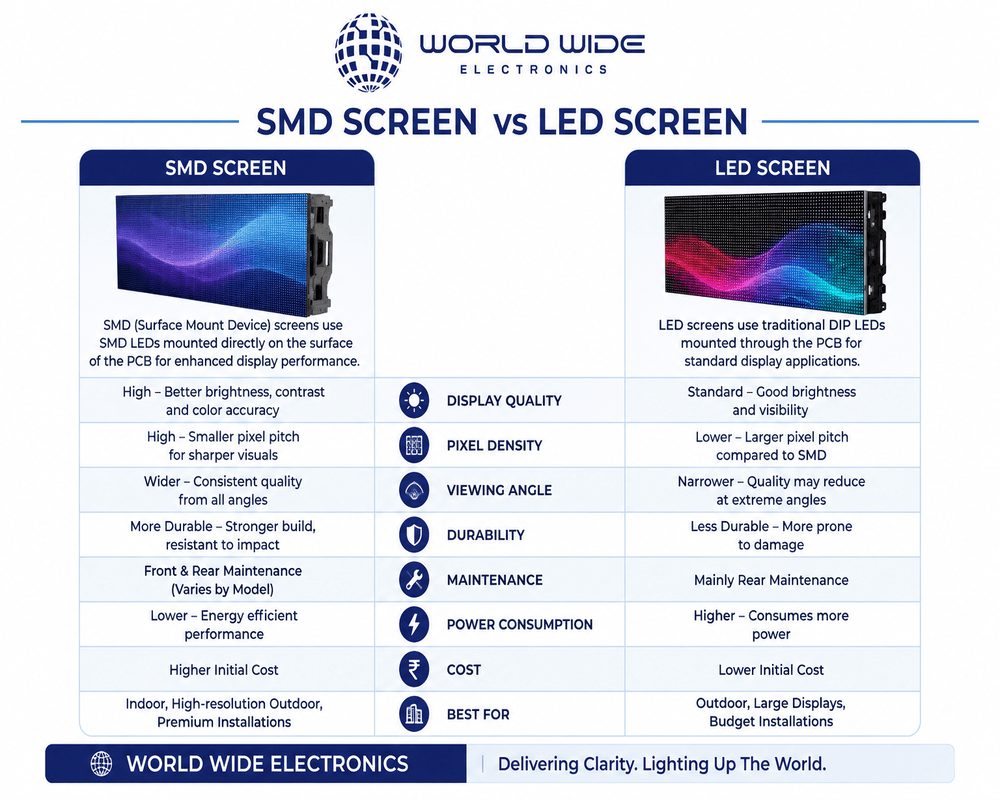
An SMD (Surface-Mounted Device) screen uses integrated RGB chips fused directly onto a panel, producing sharper images, wider viewing angles, and lower energy consumption. A traditional LED screen uses discrete diode clusters and excels in outdoor brightness. SMD screens are typically preferred for indoor commercial use, while conventional LED displays dominate large outdoor installations. Choosing the Right Display Technology Matters Every year, businesses across Pakistan and worldwide spend millions on display technology and many make the wrong choice simply because they don’t understand the difference between SMD screens and LED screens. The wrong investment can mean poor image quality, excessive power bills, or a display that simply doesn’t perform in your environment. Whether you’re a retail store owner looking to grab foot traffic, a corporate office investing in a boardroom display, or a shopping mall upgrading its advertising screens this guide is written for you. By the end of this article, you’ll know exactly which technology fits your space, budget, and audience and why that decision can directly impact your ROI. What Is a Traditional LED Screen? A Light Emitting Diode (LED) screen uses individual diodes tiny semiconductor devices that emit light when voltage is applied. In traditional LED configurations, separate red, green, and blue diodes are grouped in clusters to form each pixel. These displays were revolutionary when first introduced. They offer exceptional brightness often exceeding 6,000 nits making them ideal for direct sunlight conditions. However, their pixel structure also means there are physical gaps between diode clusters, which limits resolution at close viewing distances. Key Characteristics of Traditional LED Displays High brightness output (4,000–6,000+ nits) Larger pixel pitch (typically P6 to P16+) Designed predominantly for outdoor environments Robust and weather-resistant enclosures Lower resolution compared to SMD at same screen size Higher power consumption per square meter What Is an SMD Screen? An SMD (Surface-Mounted Device) screen is an advanced evolution of LED display technology. Rather than mounting individual red, green, and blue diodes in separate housings, SMD technology packages all three into a single, tiny, integrated chip that is soldered directly onto the circuit board’s surface. This integration is what makes SMD screens produce significantly higher resolution, smoother colour blending, and wider viewing angles compared to their traditional counterparts. SMD technology is now the industry standard for high-quality indoor smd displays. Key Characteristics of SMD Screens Integrated RGB chips in a single housing Pixel pitch as fine as P1.2 (indoor) or P2.5 (outdoor) Viewing angles up to 160° horizontal and vertical Energy-efficient — up to 40% less power consumption than traditional LED Lifespan of 80,000 to 100,000 hours Modular, lightweight panel design for easy installation Smooth, seamless image with no visible dot clusters The Core Difference Between SMD Screen and LED Screen Now that we understand what each technology is, let’s break down the critical differences across every dimension that matters to a business decision-maker. 1. Pixel Structure & Resolution Traditional LED: Uses three separate diodes per pixel (one red, one green, one blue), creating physical gaps between pixels. This limits minimum achievable pixel pitch. SMD Screen: Fuses all three diodes into one integrated chip. This allows pixel pitches down to P1.2 mm, delivering ultra-high resolution even on smaller screen sizes. For context: a 4m² SMD P2.5 screen contains approximately 640,000 pixels. An equivalent traditional LED P8 screen would have only 62,500 pixels roughly 10x fewer. 2. Viewing Angle Traditional LED: Typically offers viewing angles of 90° to 100°. Viewers at the sides or sharp angles see a degraded, dimmer image. SMD Screen: Achieves viewing angles of up to 160° both horizontally and vertically. This means consistent image quality for virtually every person in the room critical for retail floors, conference halls, and airport terminals. 3. Brightness and Outdoor Performance Traditional LED: This is where conventional LED holds a significant advantage. Peak brightness of 5,000–8,000 nits makes traditional outdoor LED visible even in direct Pakistani summer sunlight. SMD Screen (Outdoor): Modern outdoor SMD displays now achieve 4,000–6,000 nits, closing the gap considerably. Indoor SMD screens typically operate at 800–1,500 nits, which is more than sufficient for interior environments. 4. Energy Efficiency Energy costs are a major operational consideration, especially for businesses running displays 12–18 hours per day. SMD screens consume up to 40% less electricity than equivalent traditional LED displays. For a medium-sized retail display running 14 hours/day, this translates to substantial savings over a 3–5 year lifespan. A typical 20m² SMD display might consume 3,200W versus 5,600W for a traditional LED equivalent saving approximately PKR 180,000–220,000 annually in electricity costs (based on commercial rates). 5. Installation & Flexibility Traditional LED: Heavy steel cabinets, complex mounting systems, and significant structural requirements. Best suited for permanent, large-scale outdoor installations with professional engineering support. SMD Screen: Lightweight modular panels that can be assembled quickly. Curved, irregular, and creative configurations are achievable. Rental SMD systems can be set up and dismantled in hours, making them ideal for events and exhibitions. 6. Lifespan & Maintenance Traditional LED: Average lifespan of 50,000 hours. Individual diodes can be replaced, but the replacement process is labour-intensive. SMD Screen: Premium SMD panels achieve 80,000–100,000 hours of operational life. Modular panel replacement is straightforward a technician can replace a faulty panel in minutes without disrupting the entire display. SMD Screen vs LED Screen: Side-by-Side Comparison The table below provides a quick reference for decision-makers comparing both technologies across the most critical parameters. Feature Traditional LED SMD Screen Best Use Pixel Pitch 6mm – 16mm+ P1.2 – P4 (indoor) SMD for close range Viewing Angle 90° – 100° Up to 160° SMD for wide spaces Brightness 4,000 – 6,000 nits 800 – 1,500 nits (in) LED outdoor; SMD indoor Energy Use Higher Up to 40% less SMD for cost savings Installation Complex, bulky Modular, flexible SMD for ease Lifespan 50,000 hrs 80,000–100,000 hrs SMD for longevity Best Environment Outdoor/large venue Indoor/high-res needs Context-dependent “The right display technology is not about which is newer — it is about which serves your specific environment, audience, and commercial goals.”