Introduction: Your Conference Room Is Costing You More Than You Think
This scenario plays out in thousands of corporate offices every single day.
An SMD LED screen for conference rooms delivers bright, seamless, high-definition visuals in any lighting condition without the maintenance headaches of traditional projectors making meetings faster, cleaner, and more productive from day one.
For hands-on meetings and presentations, you can also compare our interactive touch panels for boardrooms.
The way we hold meetings has changed permanently. Hybrid work is the norm. Clients expect polished, professional presentations. Data-heavy dashboards demand true color accuracy. And the technology powering your meeting room needs to keep up.
The good news? The era of the SMD LED conference room display has well and truly arrived and it is more accessible than ever before.
“Viewers retain 42% more information when content is displayed on high-resolution screens.”
Harvard Business Review
What Is an SMD LED Screen and Why Does It Matter for Meetings?
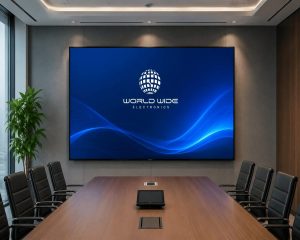
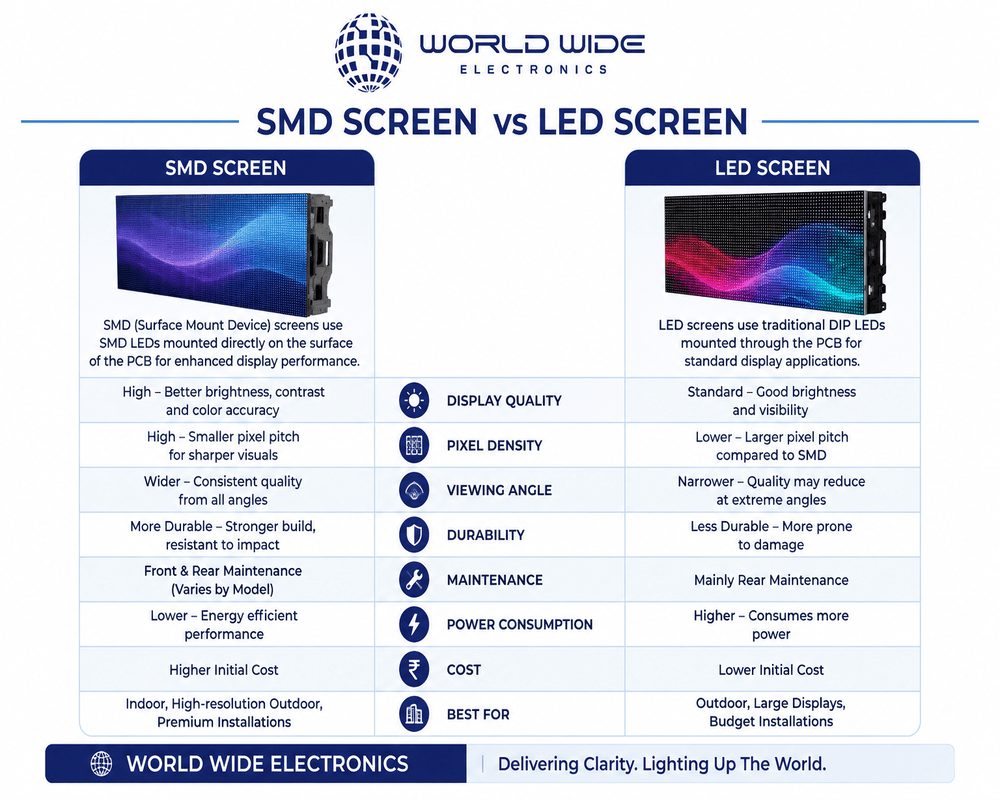
SMD stands for Surface Mount Device. It is the LED packaging technology where tiny red, green, and blue diodes are mounted directly onto the surface of a circuit board, creating pixel clusters that produce full-color images.
Unlike older DIP (Dual In-line Package) LED technology, SMD LEDs sit closer together. This produces finer pixel pitches, richer colors, wider viewing angles, and screens that look genuinely stunning up close which is exactly what you need inside a conference room.
The corporate market has taken notice. The global SMD LED displays market was valued at USD 6.5 billion in 2024 and is forecast to grow at a compound annual rate of 12.3% through 2033, reaching USD 18.46 billion. SMD technology alone held 77.20% of all LED display shipments in 2025, making it the dominant and proven choice for commercial installations.
For conference rooms specifically, the sub-10 m² panel segment is growing at a 6.97% CAGR driven directly by corporate buyers replacing projectors and LCD walls with compact LED solutions.
Conference Room LED Display vs. Projector: The Honest Comparison
This is the question every IT manager and facilities team asks before a procurement decision. Here is a straightforward breakdown.
Brightness and Ambient Light
Modern offices have natural light. Around 80% of offices now incorporate daylight through windows or glass panels, according to U.S. GSA research. Projectors require a dark or dimmed room to perform. An SMD indoor LED screen for meeting rooms typically operates at 800–1,200 nits of brightness, delivering crystal-clear visuals under full office lighting with no compromise.
Viewing Angles
SMD LED video walls for conference rooms support viewing angles up to 160 degrees. Every seat in the room whether directly in front or at the far corner sees the same consistent image. LCD panels shift in color and brightness at wider angles. Projectors create hotspots.
Lifespan and Total Cost of Ownership
A quality SMD LED display is rated for 100,000+ hours of operational life. A projector lamp typically needs replacement every 2,000–5,000 hours, and each replacement adds cost and downtime. Over a five-year period, projector maintenance costs lamps, filters, recalibration, downtime frequently exceed the cost savings of the lower upfront price.
Seamless Image Quality
LCD video walls, even with ultra-narrow bezels of 0.88mm, still have visible seams. For financial presentations, architectural drawings, or large-scale data visualization, those seams are distracting and unprofessional. An SMD LED video wall for a conference room is completely seamless by design.
Quick Reference Table
| Feature | SMD LED Screen | Projector | LCD Video Wall |
|---|---|---|---|
| Ambient Light Performance | Excellent | Poor | Good |
| Viewing Angle | Up to 160° | Variable | 170° (color shift) |
| Seams | None | None | Visible bezels |
| Lifespan | 100,000+ hours | 2,000–5,000 hrs (lamp) | 50,000–70,000 hours |
| Noise | Silent | Fan noise | Silent |
| Maintenance | Modular, front-access | Frequent | Panel replacement |
| Hybrid Meeting Support | Excellent | Limited | Good |
Choosing the Right SMD LED Screen for Your Conference Room
Step 1: Understand Pixel Pitch
Pixel pitch is the distance between the centers of two adjacent pixels, measured in millimeters. It is the single most important specification for an indoor LED screen in a meeting room.
The smaller the pixel pitch, the sharper the image at close distances. For conference rooms where participants typically sit within 2–4 meters of the screen, you need a fine pitch display.
Industry recommendations for conference room installations:
- P1.2 to P1.5mm — Premium boardrooms and executive suites. Viewers within 1.5–3 meters. Ultra-sharp text and fine data visualization.
- P1.5 to P2.5mm — Standard mid-size conference rooms. Viewers at 2–4 meters. The most popular range for corporate meeting spaces. Delivers 4K-equivalent clarity.
- P2.5 to P3.91mm — Larger training rooms and auditoriums. Viewers at 4–8 meters. A cost-effective choice where viewers are seated further back.
A practical rule: multiply the pixel pitch by 1,000 to get your minimum viewing distance in meters. A P2 display needs viewers at least 2 meters away for a sharp image.
Step 2: Calculate the Right Screen Size
Screen size should be proportional to your room. A screen that is too small defeats the purpose. One that is too large can overwhelm a small space.
For most conference rooms, the screen width should be approximately one-third to one-half of the room’s length. If your room is 6 meters long, a screen between 2 and 3 meters wide works well for the majority of setups.
Common conference room SMD LED screen sizes:
- Small rooms (under 20 sqm): 2m x 1.1m to 2.4m x 1.35m
- Medium rooms (20–40 sqm): 3m x 1.7m to 4m x 2.25m
- Large boardrooms and training rooms (40+ sqm): 4m x 2.25m and above
Step 3: Check Brightness Specifications
For indoor conference rooms with controlled lighting, 600–1,200 nits is the target range. You do not need outdoor-level brightness inside. Excessively bright screens cause eye fatigue during long meetings.
If your meeting room has large windows or south-facing glass, stay toward the higher end of that range.
Step 4: Confirm Integration Compatibility
Your new corporate meeting room display solution needs to work with your existing ecosystem. Before ordering, confirm:
- Video conferencing platform support: Does it natively integrate with Zoom, Microsoft Teams, and Google Meet?
- Input sources: HDMI 2.0, DisplayPort, USB-C, wireless casting
- Control systems: Compatibility with Crestron, Extron, or AMX if you run those systems
- Multi-source switching: Can it display content from two sources simultaneously for hybrid meetings?
Modern SMD LED conference room displays come with built-in video processors that support all of the above. This level of connectivity is one of the biggest practical upgrades over aging projector systems.
“67% of companies need their AV systems to support at least two major video conferencing platforms simultaneously.”
Futuresource Consulting
Real-World Scenarios: How Different Organizations Use SMD LED Displays
Corporate Headquarters and Executive Boardrooms
A financial services firm with a 40-person boardroom replaces three aging projectors with a single seamless P1.5 LED video wall. The result: quarterly financial reviews are now conducted with real-time data feeds, multi-source split-screen capability, and zero setup time before meetings. The CFO notes that pre-meeting technical difficulties — which previously consumed 15–20 minutes per session have dropped to near zero.
Training Departments and HR Teams
An HR director managing a company-wide upskilling program installs a P2 SMD LED screen in each of six training rooms. The consistency of color calibration across every room means training materials look identical regardless of which room is used. Facilitators no longer carry HDMI adapters and adapters for adapter cables.
Hotels and Convention Centers
A five-star hotel’s main conference hall upgrades from a rear-projection system to a modular LED video wall. The panels can be reconfigured quickly between room layouts. Clients booking the space now see the LED wall as a feature, not just a tool it contributes to the decision to rebook.
Co-Working Spaces
A premium co-working provider installs SMD LED screens in its private meeting rooms as a differentiator. The bright, always-on displays mean members can walk in, connect wirelessly, and start their meeting in under 30 seconds. No cables to hunt for. No remote controls. No projector bulbs to replace.
Government Offices and Command Centers
Government departments and public sector agencies are deploying fine-pitch LED video walls for briefing rooms and situation rooms where large-format, multi-source display is non-negotiable. The modular nature of SMD LED panels allows for precise sizing to match unusual room geometries common in older government buildings.
Key Benefits of Installing an SMD LED Screen in Your Conference Room
1. Zero Warm-Up Time
SMD LED screens are instant-on. Press a button and the display is ready within seconds. No waiting for lamps to reach full brightness.
2. Silent Operation
Projectors generate fan noise that is noticeable in quiet meeting environments. SMD LED displays are completely silent, which matters more than most buyers realize until they experience their first truly quiet boardroom.
3. Modular Maintenance
If a panel section develops an issue, individual modules can be replaced from the front without dismantling the entire installation. Many modern designs support tool-free front-access maintenance.
4. Content Flexibility
Run a live video conference on one side of the screen while displaying a presentation on the other. Show multiple camera feeds simultaneously. Display real-time dashboards alongside presenter slides. SMD LED technology handles all of this without breaking a sweat.
5. Long-Term Investment Protection
LED display technology is software-upgradeable. The physical hardware you install today can be updated to support new content management features and connectivity standards through firmware updates, extending the useful life of your investment.
6. Brand Impression
The first thing a visiting client or potential partner notices when they walk into your boardroom is the display setup. A seamless, high-brightness LED video wall signals that your organization takes quality seriously. That first impression has real commercial value.
Installation Considerations for IT Managers and AV Professionals
Wall Mounting vs. Floor Standing
Most conference room LED walls are wall-mounted for a clean, permanent finish. Floor-standing frames are available for spaces where wall mounting is not practical — leased offices, for example, or rooms that serve multiple purposes.
Power and Cabling
Plan your power distribution carefully. A 3m x 1.7m LED wall at P2 will typically draw between 500W and 900W at maximum brightness. This needs to be factored into your room’s electrical load planning. Your installation partner should provide a detailed power specification before work begins.
Cable Management
All HDMI, DisplayPort, and power cables should route through conduit in the wall or ceiling. Surface-mounted cables look unprofessional and create trip hazards. Proper cable management is the difference between a clean installation and one that becomes a source of ongoing frustration.
Ambient Light and Room Design
If you are designing a new conference room or undertaking a full fit-out, consider the relationship between window placement and screen position. Avoid direct sunlight hitting the screen surface at peak brightness hours. This is less critical with LED than with projectors, but it is still worth planning for.
SMD LED Screen for Conference Rooms: Common Questions Answered
How long will the screen last?
Quality SMD LED displays are rated for 100,000 hours of operational life. Running the display for 10 hours per day, every working day, that is over 27 years of theoretical lifespan. In practice, most corporate environments will see 10–15 years of reliable service before any significant performance degradation.
Is the installation disruptive?
Modern SMD LED conference room systems are designed for fast deployment. A typical meeting room installation with a clean wall can be completed in under 24 hours. For renovations, work is usually scheduled over a weekend to avoid business disruption.
Can it work with our existing video conferencing setup?
Yes. Contemporary SMD LED displays connect via standard HDMI or DisplayPort outputs from your room’s video conferencing codec, PC, or wireless presentation system. They integrate with Zoom Rooms, Microsoft Teams Rooms, and similar unified communications platforms without proprietary hardware.
What is the difference between an SMD LED display and a flat-panel commercial TV?
Commercial flat-panel TVs are fixed in size and resolution. SMD LED displays are modular you choose the exact size and aspect ratio you need. They also offer significantly higher brightness, better viewing angles, and a lifespan typically two to three times longer than commercial LCD panels.
What pixel pitch should I choose for a small meeting room?
For a meeting room where viewers sit 2–3 meters from the screen, P1.5 to P2 is the right range. This delivers sharp text and detailed visuals at typical conference room distances without overspending on pixel density you cannot perceive at that range.
How to Buy an SMD LED Screen for Your Conference Room in Pakistan
If you are based in Pakistan and looking for a reliable supplier for corporate meeting room display solutions, the key criteria to evaluate are:
Product quality certification: Look for CE, RoHS, and EMC certifications. These confirm the product meets international safety and performance standards.
After-sales support: LED wall technology requires technical support post-installation. Choose a supplier with qualified engineers who can provide on-site service, not just replacement parts shipped in a box.
Local inventory: Suppliers with locally held stock can reduce lead times dramatically compared to ordering direct from overseas factories with 6–8 week shipping windows.
Installation expertise: The quality of the installation matters as much as the quality of the product. Panels that are not perfectly calibrated during installation will show color inconsistency that is difficult to fix without expertise.
At Worldwide Electronics, we supply and install SMD LED screens for conference rooms across corporate offices, government institutions, hotels, and educational facilities throughout Pakistan. Our team handles everything from room assessment and product recommendation through to installation, calibration, and after-sales support.
→ Browse our Conference Room LED Display solutions to find the right product for your space and budget.
Conclusion: It Is Time to Upgrade Your Conference Room
The evidence is clear. An SMD LED screen for your conference room is not a luxury upgrade it is a practical investment in cleaner meetings, better presentations, and a more professional working environment.
The projector era served its purpose. But in 2026, with hybrid meetings as the norm, demanding clients expecting polished presentations, and a global LED display market moving decisively toward fine-pitch indoor solutions, sticking with aging projection technology is the riskier choice.
SMD LED technology delivers:
- Instant-on operation with zero warm-up
- Crystal-clear visuals in any lighting condition
- Silent, maintenance-free performance
- Seamless integration with modern AV and conferencing systems
- A 100,000-hour lifespan that far outlasts alternatives
Whether you are upgrading a single boardroom or specifying display solutions for an entire campus, the guidance in this article gives you the foundation to make the right decision.
Take the Next Step
Ready to transform your meeting space? The team at Worldwide Electronics has helped corporate offices, hotels, government agencies, and educational institutions across Pakistan install the right SMD LED display solutions for their specific needs.
Contact Worldwide Electronics today for a free consultation and customized quote for your conference room project.