Quick answer: The main types of stage lights are PAR cans, moving heads, beam fixtures and wash lights, with spot and strobe fixtures used for specific effects. Each type does a different job. PAR lights give even colour wash, moving heads add movement and focus, beams create sharp shafts of light in the air, and washes fill the stage with soft colour. Most shows combine two or three types. Knowing what each one is for helps you ask for the right kit and avoid paying for lights your event does not need.
Event organisers often hear a list of lighting names from a supplier and have no easy way to compare them. This guide, from the team behind our stage lighting solutions for events in Pakistan, explains each main type in plain language. It covers what the light does on stage, where it works best, what to check before you hire or buy, and how the types are usually combined for a concert, wedding, awards night or conference. For the lighting fixtures a controller drives, see our DMX lighting controller basics guide.
PAR Lights: Even Colour and Wash
A PAR light takes its name from the parabolic aluminised reflector inside the fixture, which throws a fairly even beam of light. Many older PAR cans used simple lamps, and many modern ones use LEDs. The beam is usually soft at the edges and gives a broad, even colour across the area it covers.
PAR lights suit the following jobs:
- Stage washes: a row of PAR cans can colour the backdrop or the performers’ area evenly.
- Uplighting: placed low and aimed up, they give a warm glow to walls, drapes and columns at weddings and gala dinners.
- Background colour: they set the mood for a stage without drawing attention to themselves.
PAR lights are usually the lowest cost option per fixture, and they are simple to run. Their weakness is movement. A PAR can change colour, but it cannot sweep across the stage, so for dynamic shows you will need another type alongside it.
Moving Heads: Movement, Focus and Colour
A moving head is a fixture that can pan and tilt, so the operator can aim the beam anywhere in the room from the lighting console. Most moving heads also change colour, pattern and beam width, and many can rotate gobos, which are patterned stencils that project a shape onto the stage or the audience.
Moving heads are the main tool for energetic shows. They can follow a performer, sweep across the crowd, and build a changing picture in time with the music. Their main limits are the following:
- Set-up time: each head must be placed, aimed and programmed, so they take longer to prepare than a PAR wash.
- Operator skill: a good show needs someone who can programme cues, not just switch the lights on.
- Mounting: heads need solid points to hang from, such as a truss, and the load must be checked. Our guide to box truss vs triangle truss explains how the frame choice affects what you can hang.
For a wedding, a small number of moving heads can add movement without overwhelming the room. For a concert, many more are used, often with beam and wash fixtures between them. Before hanging any rig, check the truss load capacity and safety checklist in our guide.
Beam Lights: Sharp Shafts of Light
A beam fixture produces a narrow, bright shaft of light with very little spread. When there is haze or smoke in the air, the beam becomes visible as a line that cuts through the room. This is the look most people associate with a large concert or a nightclub.
Beams are good for these effects:
- Visible light lines that move across the ceiling and the crowd.
- Fast, sharp movement that adds energy to a dance track or an entrance.
- Creating depth, because the lines show the shape of the room.
Beam lights need haze to show their full effect. Without it, the light lands as a small bright spot on the floor. Check with the venue whether haze is allowed and plan the air quality for performers and guests.
Wash Lights: Soft Colour Across the Stage
A wash light has a wide beam and a soft edge. It is designed to cover a large area with even colour, rather than to create a sharp shape. Many wash fixtures are moving heads with a wide beam setting, so they combine the wash look with movement.
Washes are often the base of a stage design. They light the performers and the set so that the cameras and the audience can see faces and colours clearly. A wash layer is usually added before any beam or spot effects, because it sets the colour balance for the whole show.
Spot and Strobe Fixtures: Specific Effects
A spot fixture gives a focused, controllable pool of light, often used to pick out one performer or a single object. A strobe produces fast flashes, used for impact moments in a show. Both are useful in small doses. A strobe used for long periods can tire the audience and may not suit every venue, so check the rules with the event organiser before you plan one.
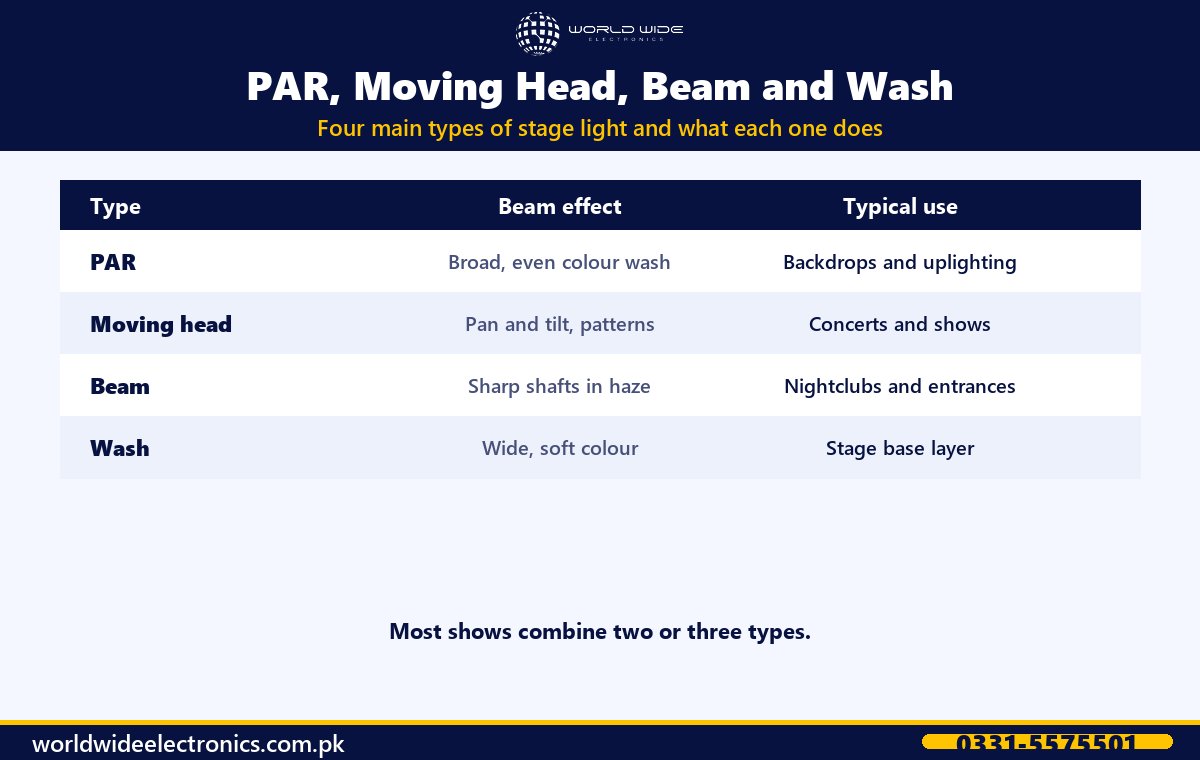
Comparison of the Main Types
The table below shows how the main types compare. The right mix depends on the event, the size of the venue and the budget.
| Type | Main effect | Movement | Typical use |
|---|---|---|---|
| PAR | Even colour wash | None (fixed) | Backdrops, uplighting, weddings |
| Moving head | Focused beams, patterns and motion | Pan and tilt | Concerts, shows, dance floors |
| Beam | Sharp light shafts | Usually moving | Nightclubs, large concerts, entrances |
| Wash | Wide, soft colour | Fixed or moving | Stage base layer, speaker and set colour |
| Spot | Focused pool of light | Fixed or moving | Speakers, awards, one performer |
| Strobe | Fast flashes | None | Short impact moments |
How the Types Work Together
Most good lighting designs use layers. A common approach for a small stage is to start with a wash for the base colour, add PAR cans for the backdrop, and use two or three moving heads for movement. Beams and spots are added where the programme needs them, and strobes are kept for a few key moments.
For a wedding or a conference, the layers are usually simpler: a PAR or wash layer for the stage and speakers, and some uplighting for the room. For a concert, the design is much more detailed, with the stage, the crowd and the cameras all planned together. Share the event timeline with your supplier so they can plan the layers around the programme, not around a fixed list of fixtures.
What to Check Before You Hire or Buy
Lighting kit looks similar in a catalogue, but the details decide how well it works on the day. Before you commit, check these points:
- Brightness for the room: a fixture that looks bright in a dark warehouse may look weak in a hall with daylight or a bright ceiling.
- Power and cabling: confirm the power draw, the number of fixtures per circuit and the cable routes.
- Control: ask who will operate the lights and whether a pre-programmed show is included.
- Rigging: check the mounting points, the weight limits and who is responsible for safe rigging.
- Back-up: ask what happens if one fixture or controller fails during the show.
Sound and light are usually planned together. Our guide to how many watts a sound system needs for an event is useful when you plan the audio side of the same stage.
Common Mistakes to Avoid
- Using only one type: a stage with only PAR cans looks flat, and a stage with only beams can be too harsh for faces.
- Ignoring the camera: lights that look good to the eye may not work on video, so test the colours with a camera if the event is filmed.
- Skipping the rehearsal: cues that look right on paper often need a few adjustments once the stage is set up.
- Overusing strobes and moving effects: constant movement tires the audience and can distract from the performers.
Related guides: Sound and Lighting Services in Pakistan and Planning a High-Tech Event in Pakistan.
Frequently asked questions
What is the difference between a PAR light and a moving head?
A PAR light is a fixed fixture that gives an even colour wash. A moving head can pan and tilt, so its beam can move across the stage or the crowd. PAR lights are usually simpler and cheaper, while moving heads add movement and focus.
Do I need haze for beam lights?
Beam lights are most striking when haze or smoke is present, because the shafts of light become visible in the air. Without haze, beams mainly appear as bright spots on surfaces. Check the venue rules before you plan haze.
Which stage light is best for a small wedding?
For most small weddings, PAR lights or wash lights for even colour and uplighting for the room work well. A few moving heads can add movement for the first dance or the entrance, if the budget and the space allow.
Are LED lights better than older lamp-based fixtures?
LED fixtures are generally more energy efficient, produce less heat and need less maintenance than older lamp-based fixtures. The right choice still depends on the effect you need, the brightness for the room and the budget, so compare the specifications for each option.