Quick answer: Sound system wattage for events depends on crowd size, venue and music type. Measure the coverage area first, choose speakers that reach the back row comfortably, then add subwoofers only if the music needs bass. Check each speaker’s sensitivity and power rating on its spec sheet, and have an engineer confirm the design.
If you want us to design and supply the system, see our sound systems for events page. Every event organiser asks the same question about sound system wattage for events: how many watts do I need? The honest answer is that watts alone do not decide the result. A 500-person wedding hall and a 500-person open ground need very different systems, even when the watt figures look similar on paper. This guide explains how to plan the sound before you choose the equipment.
Why Watts Alone Do Not Decide Loudness
A watt is a unit of electrical power. A speaker’s loudness depends on how efficiently it turns that power into sound, which the manufacturer shows as sensitivity, and on how far the sound must travel. Two speakers with the same watt rating can produce very different levels in the same room. That is why a spec sheet should always be read as a set of numbers, not as a single figure.
Power also has to be matched to the amplifier and the cables. Power is voltage multiplied by current, so the electrical load of an amplifier depends on both the speaker impedance and the mains supply. A system designed for the right wattage but connected to a weak supply will sag, distort and cut out at the worst moment. Plan the power supply and generator capacity as part of the sound design.
Step 1: Measure the Coverage Area
Start with the space the sound must reach. Measure the length and width of the audience area, the distance from the stage to the last row, and the height of the speakers above the floor. A long, narrow hall needs a different layout from a square room. Outdoor events have fewer reflections, so the sound travels further, but the wind and the background noise also change how the system performs.
Include the stage and the back of the audience in your count. Many organisers only plan for the front rows, then find that people at the back cannot hear speech or vocals clearly. A simple sketch with dimensions is enough for a first estimate, and it makes the discussion with a sound engineer much faster.
Step 2: Understand Distance and Level
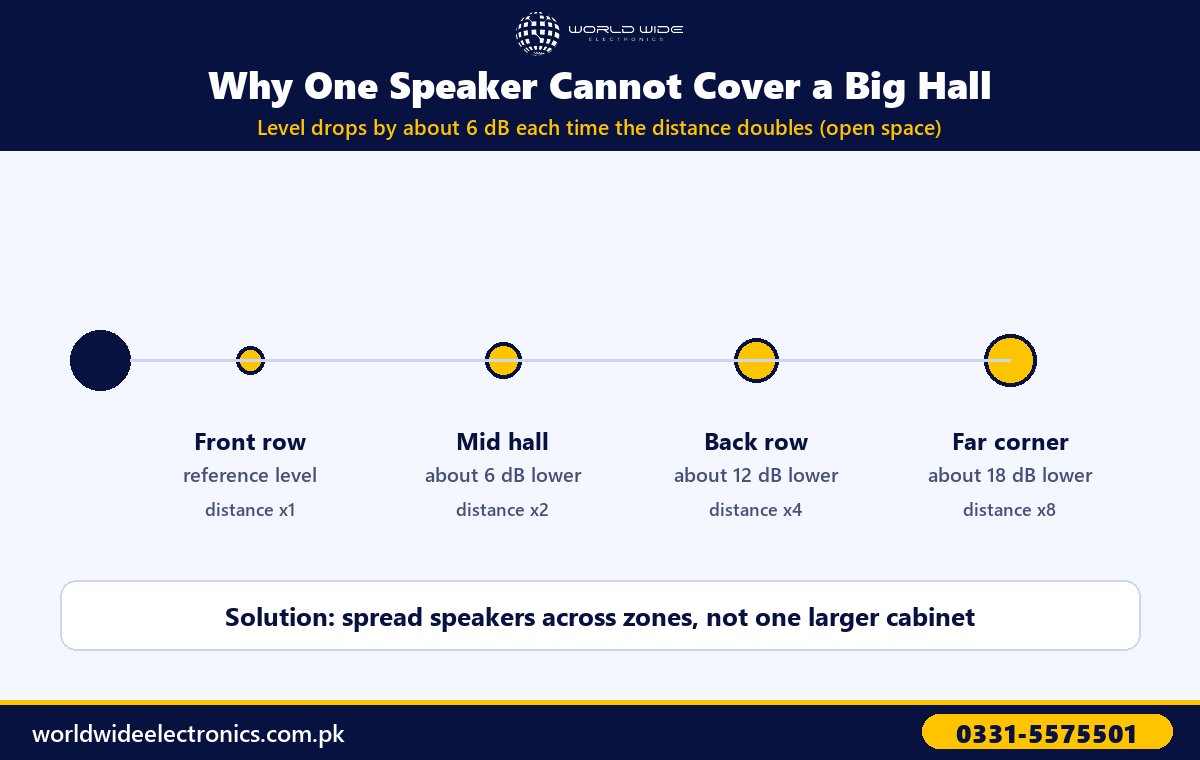
Sound spreads out as it travels. In an open space, when you double the distance from a point source, the level drops by about 6 dB. This is the inverse square law, a basic physics rule that applies to most speaker designs in the open. The practical result is that a speaker placed at the front of a large audience cannot be turned up enough to serve the back row without the front rows becoming uncomfortably loud.
The fix is usually a line of speakers, or several speaker positions spread across the venue, each covering its own zone. A line array or a set of distributed speakers keeps the level even across the audience. For a single speaker in a small room, one good cabinet may be enough. The choice is about coverage, not about buying the largest watt figure.
Step 3: Choose the Main Speakers
Main speakers carry the vocals, speech and the mid and high frequencies. Choose them by coverage pattern, which tells you how wide and how far the sound reaches, and by the sensitivity and power rating from the spec sheet. Compare the same type of data for each option. A speaker with a higher sensitivity needs less amplifier power to reach the same level, so it can be a better choice than a speaker with a larger power rating but lower efficiency.
For a wedding or conference, a clear, well-placed set of speakers with good speech intelligibility matters more than raw volume. For a concert or a live band, the bass and the dynamic range matter more. Tell the engineer what the event is for, so the design matches the way the sound will be used.
Step 4: Add Subwoofers for Bass
Subwoofers handle the low frequencies that carry the beat of music. They do not need to be loud in every direction, so they can often be placed at the front, under the stage or at the side of the audience. Low frequencies are non-directional, which makes placement more flexible than with the main speakers. Use a sub only where the music needs it: a dance event or a live band has a bass requirement, while a speech or a conference usually does not.
Too much bass is a common mistake. A sub that is set too loud for the room makes the event muddy and tiring, and it can damage the main speakers if the crossover is not set correctly. Ask for the crossover settings and the sub placement in the design drawing, and test them at the venue before guests arrive.
Step 5: Plan Power, Cables and Backup
Once the speakers are chosen, add up their power draw, including the amplifiers, mixer, processor, microphones and lights on the same circuit. Use the watt rating from each device’s spec sheet to total the load, then add a margin so the system does not run at its limit all evening. Check that the venue’s supply can carry the total, and plan a generator if the supply is not stable. Use correct cable sizes for the length of each run, because a thin cable loses power over distance and can overheat.
Load shedding and power cuts are a real risk in many parts of Pakistan. Ask whether the venue has a generator, whether it can start within a few seconds, and whether the sound system can handle the voltage change without a restart. A UPS can protect the mixer and the processor, but it is not a replacement for a generator on a long event. Our guide to SMD screen power consumption explains the same planning steps for an LED screen on the same site.
Common Mistakes When Sizing a Sound System
- Buying by the watt figure alone. Compare the coverage pattern and sensitivity, not only the power rating.
- Planning for the front row only. Check the level at the last row, the side seats and the back of any balcony.
- Using one speaker for a large hall. A single cabinet cannot cover a wide audience evenly without a loud front and a weak back.
- Ignoring the room. Hard walls, glass and high ceilings make the sound bounce and blur speech. Soft furnishings and a good speaker position help.
- Forgetting the power supply. A system that runs on a weak supply will fail when the event is at its busiest.
Checklist Before You Book Sound for an Event
- Write down the number of guests, the venue type and the event purpose: speech, music or both.
- Measure the coverage area and sketch the speaker positions, including the stage and the last row.
- Ask for the coverage pattern, sensitivity and power rating of each speaker on the spec sheet.
- Add subwoofers only where the music or the event needs them, and test the crossover on site.
- Total the electrical load, check the supply and agree a generator or UPS plan with the venue.
Related guides: Sound and Lighting Services in Pakistan and Planning a High-Tech Event in Pakistan.
Frequently asked questions
How many watts do I need for 500 people?
There is no safe single figure, because the venue, the speaker coverage and the type of event change the result. Start with the coverage area and the speaker layout, then match the sensitivity and power ratings to the level you need at the back row. A sound engineer can give a figure after measuring the venue.
Is more watts always louder?
Not always. Loudness depends on the speaker’s sensitivity, how many speakers are used and how far the sound must travel. A more efficient speaker can be louder than a higher-rated speaker that is less efficient.
Do I need a subwoofer for a speech or a conference?
Usually not. Speech sits mostly in the mid frequencies, so the main speakers handle it well. A subwoofer is useful for music, dance events and live bands where the bass carries the energy of the show.
Should I use a generator or a UPS for the sound system?
Use a generator for the full event if the mains supply is unstable, and use a UPS to protect the mixer and processor during the switch. A UPS on its own will not run the system for a long event. Test the changeover before guests arrive.