Quick answer: Box truss vs triangle truss depends on shape and load. A box truss has a square section and joins at right angles, so it suits flat screens and rectangular stages. A triangle truss is lighter for its strength and handles curves and round stages. Confirm the load rating on the spec sheet before you order.
For the full range of structures we supply and install, see our stage truss systems page. If you are planning a stage, a concert backdrop or an exhibition booth, the first structural decision is usually the same: box truss vs triangle truss. Both are aluminium lattice systems, and both can carry lights, speakers and LED screens. They behave differently under load, fit different shapes and cost differently to transport and assemble. This guide explains the differences so you can match the truss to the event.
What Is a Box Truss?
A box truss, also called a square truss, is built from four main chords that form a square section. Cross braces join the chords at regular intervals, and the sections connect end to end with bolted or pinned joints. Because each face is flat and the joints meet at 90 degrees, the box truss is simple to lay out on the ground, easy to square up and natural for mounting flat panels.
Most stage and screen rigs in Pakistan use a box truss for the front truss, the screen frame and the lighting bar, because the flat faces make it easy to fix LED cabinets, brackets and motors. Box truss is also a common choice for exhibition stands and trade shows, where walls, banners and screens need straight, square edges.
What Is a Triangle Truss?
A triangle truss has three chords that form a triangular section. The triangle is a rigid shape, so the structure resists twisting and bending well for the amount of metal used. The sections are lighter per metre than an equivalent box section, which makes triangle truss easier to carry, faster to assemble and often more economical to ship.
Triangle truss is the usual choice for curved or round stages, roof structures, circular lighting rigs and any layout that needs a bend or a corner. Because the sections can be joined at many angles, a designer can build a circle, an arch or a crown without special parts. The trade-off is that a triangle truss needs more care with flat mounting, because the faces are not flat.
Box Truss vs Triangle Truss: Side by Side
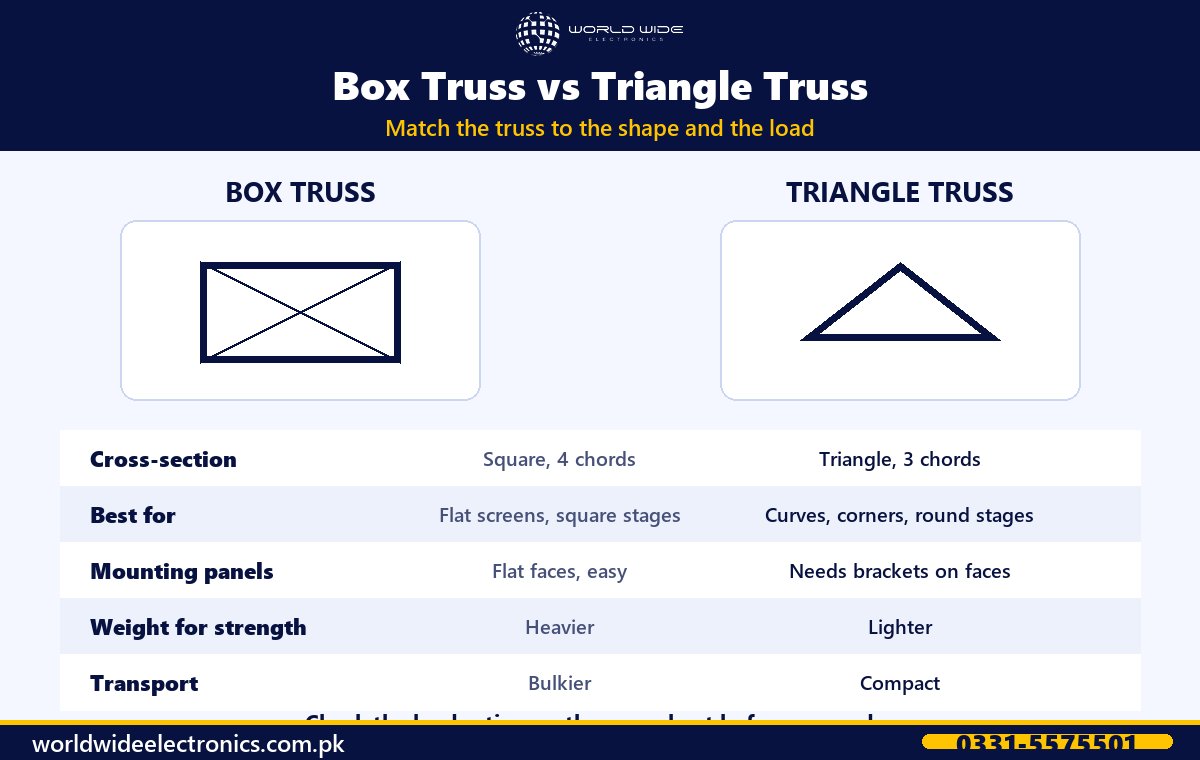
The table below summarises the main differences. Treat it as a starting point and check the actual figures on the spec sheet of the system you plan to use.
| Factor | Box truss | Triangle truss |
|---|---|---|
| Cross-section | Square, four chords | Triangle, three chords |
| Best for | Flat walls, LED screen frames, rectangular stages | Curves, corners, round stages, roof structures |
| Mounting flat panels | Easy, flat faces on all sides | Needs brackets or adaptors on the faces |
| Weight for its strength | Heavier for the same strength | Lighter for the same strength |
| Transport and storage | Bulkier, more volume per section | Compact, easier to load |
| Assembly | Quick on a flat floor, square layouts | Quick, but needs the layout drawn for angles |
Read the table by asking one question at a time. First, what shape does the stage or screen need? If the answer is flat, the box truss is the simpler route. If it is curved, round or has corners, the triangle truss usually saves work. Second, what is the load? A lighter structure is easier to set up and ship, but only if its rated load covers every light, speaker and cable you plan to hang.
Which Truss Suits an LED Screen?
An LED screen needs a flat, rigid frame that keeps every cabinet level and in line. For a fixed wall of screens, a box truss is usually the simpler option, because the cabinets and brackets fit square to the faces and the frame is easy to check with a spirit level and a square. If the screen will hang on a stage, the frame must also carry the cabinets, cables and control equipment without flexing.
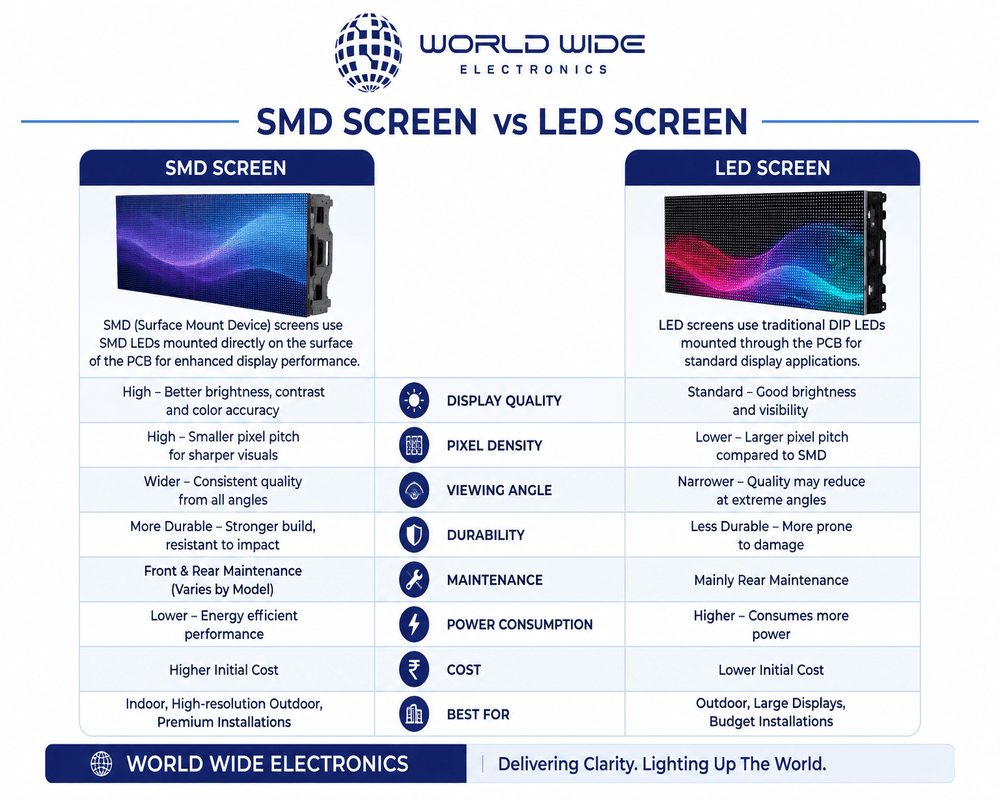
A curved LED screen changes the picture. A triangle truss, or a box truss built with a curved arrangement of sections, can follow the shape of the screen, but the designer must work out each joint angle and the mounting points. For a standard flat screen at a mall, hotel or stadium, box truss is the normal choice. For a curved screen or a circular display, a triangle structure is often the better fit. Our SMD screen team can help you match the frame to the screen layout before the order is placed.
Which Truss Suits a Stage and Event Lighting?
Lighting is the heaviest part of most event rigs. Moving heads, LED bars, speakers and rigging motors all hang from the truss, so the structure is chosen by its load rating and by where each load sits. A box truss is common for front of house lighting bars and for the main stage span, because the flat faces take clamps and brackets easily and the layout is simple to measure.
A triangle truss is common for round stages, roof rigs and circular lighting positions, and for long spans where weight matters during transport and setup. Many productions use both: a box truss for the stage frame and a triangle truss for the overhead rig. If you are planning a full event, our guide to planning a high-tech event in Pakistan shows how the truss, screen, sound and lighting fit together on site.
How to Check the Load Before You Choose
The shape of the truss is only half the decision. The other half is the load: the total weight of the lights, speakers, screens and cables, plus the dynamic forces from movement and wind if the structure is outdoors. Each truss section has a rated load for a given span and support pattern. These ratings come from the manufacturer’s tests and should be read from the spec sheet, not guessed from the look of the structure.
Ask an engineer to check the layout for three things: the maximum point load on each joint, the span between supports, and whether the structure is hung or ground supported. A truss that is safe on the floor may need a different configuration when it is hung high over an audience. Do not add weight to a section beyond its rating, and do not use a truss for a load it was not designed to carry.
Common Mistakes When Choosing a Truss
- Choosing by price per metre. A cheaper section with a lower rating may need more supports, more ground space and more labour, which removes the saving.
- Mixing truss systems. Sections from different makers do not always share pin sizes or bolt patterns. Use one system for the whole structure.
- Ignoring the screen mounting. A flat screen on a triangle truss needs extra brackets, and a curved screen on a box truss needs extra joints. Plan the mounting before the frame.
- Forgetting the cable route. Power and data cables need a path along the truss. Leave room for them when you choose the section size.
- Skipping the layout drawing. A simple drawing with dimensions, support points and load positions prevents most site problems.
Checklist Before You Order a Truss
- Write down the stage or screen shape: flat, curved, round or mixed.
- List every load to hang or stand on the truss, with its weight from the spec sheet.
- Decide whether the structure will be hung or ground supported, indoors or outdoors.
- Choose the section type from the shape and the mounting needs, then check its load rating.
- Ask for a layout drawing and have an engineer confirm the load before the order is confirmed.
Related guides: Planning a High-Tech Event in Pakistan and SMD Screen for Events in Pakistan.
Frequently asked questions
Is box truss or triangle truss stronger?
Neither is stronger in every case. The strength depends on the section size, the wall thickness of the chords, the span and how the truss is supported. Compare the load ratings of the exact sections on the spec sheet, not the shape alone.
Can I use triangle truss for an LED screen?
Yes, if the screen is curved or circular, or if the frame needs to be lighter. A flat screen is usually simpler on box truss because the cabinets fit the square faces. Ask an engineer to check the mounting points for the cabinet weight.
Which truss is better for outdoor events?
Both can be used outdoors, but wind load, ground conditions and the anchor points matter more than the shape. Outdoor structures need an engineer’s check and a plan for ballast or fixings. Do not assume a structure rated for indoor use is safe outdoors.
Do I need a special tool to assemble a truss?
Most systems use standard bolts or quick-release pins and a torque or pin check on each joint. The manufacturer’s manual states the tools and the joint checks. Assemble the structure with trained people, and check every joint before anything is hung.