Quick answer: COB vs SMD is mainly a question of how the LED chips are packaged and mounted. SMD (surface-mounted device) puts each red, green and blue LED in its own small package on the board. COB (chip-on-board) bonds the bare LED chips straight onto the board and covers them with a protective layer. SMD is the more common choice for most indoor and outdoor screens. COB suits very fine pitch indoor displays where a smooth, well-protected surface matters most. Cost, repair and viewing distance are the main trade-offs.
Our team supplies SMD screens across Pakistan, and buyers often ask us to compare them with COB. You will hear both names when you request quotes for a showroom, a boardroom or an event. Both technologies can produce a sharp picture, and both are used in real projects. The right choice depends on how close people will stand, how the screen will be handled and what budget you have. This guide sets out the differences so you can ask the right questions before you order.
What Each Technology Means
The names describe how the LED is built onto the board, not the screen’s quality or brand.
- SMD: each LED is a small, individually packaged component soldered onto the circuit board. SMD is used across indoor, outdoor, rental and large-format screens, and it covers a wide range of pixel pitches.
- COB: the bare LED chips are attached directly to the board, without a separate plastic package for each one. A protective coating then covers the chips, giving a flat and tough surface.
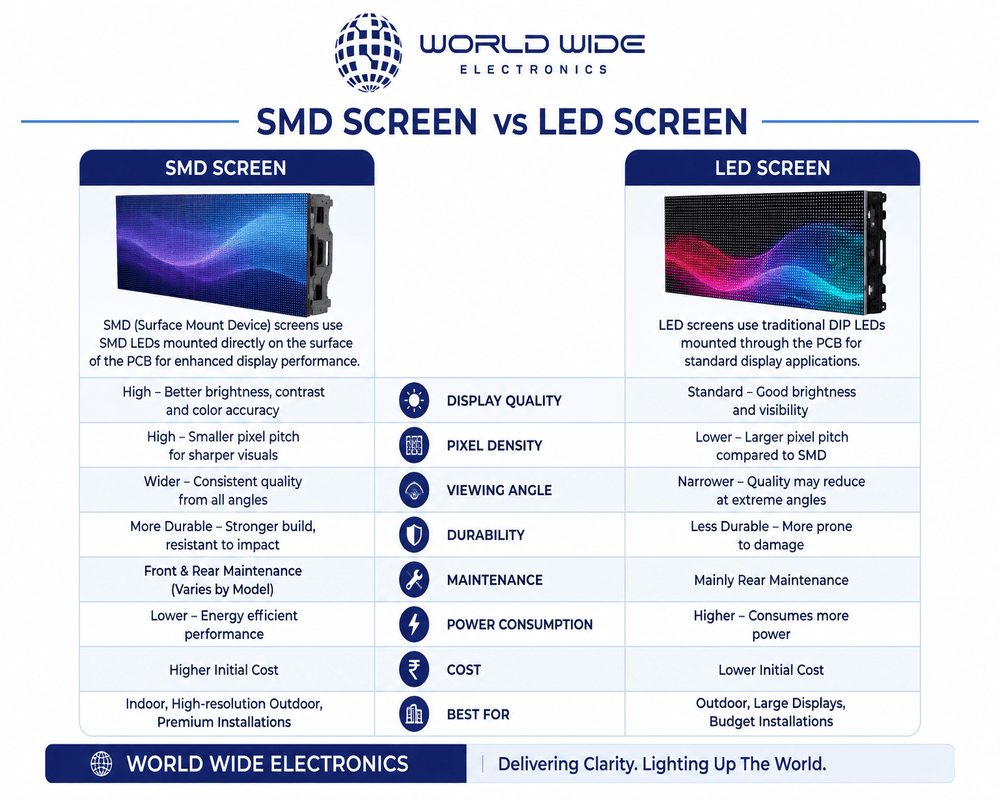
For the basic difference between an SMD screen and a general LED screen, read the difference between SMD screen and LED screen. This article focuses on the comparison between SMD and COB packaging.
COB vs SMD at a Glance
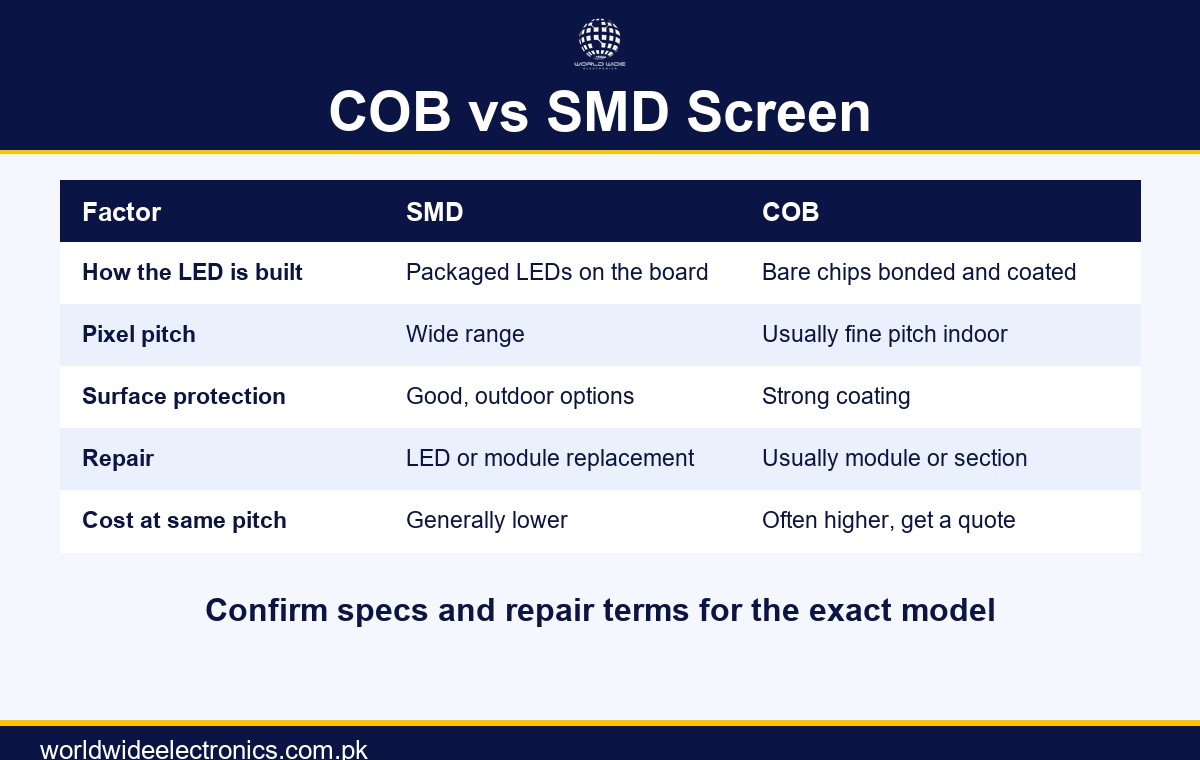
The table below gives a general comparison. Actual performance depends on the product, the pixel pitch and the supplier, so always confirm the details on the spec sheet for the model you are considering.
| Factor | SMD | COB |
|---|---|---|
| How the LED is built | Individually packaged LEDs soldered onto the board | Bare chips bonded to the board and coated |
| Typical pixel pitch range | Wide range, from fine to coarse | Usually used for fine pitch indoor screens |
| Surface protection | Good, with added protection for outdoor models | Strong, with the coating protecting the chips |
| Repair | Individual LEDs or modules can be replaced | Usually replaced as a module or section |
| Availability | Widely available | More limited, depending on the model |
| Cost at the same pitch | Generally lower | Often higher, so ask for a quote |
Pros and Cons of SMD Screens
SMD is the most widely used LED packaging for commercial screens. Its main advantages are:
- Range of options: SMD is available across many pixel pitches, sizes and brightness levels, so you can match the screen to the job.
- Easy to source: SMD modules are common in the market, which helps with replacement parts and comparison quotes.
- Suits outdoor use: SMD outdoor modules are widely used on shopfronts, billboards and facades, with protection suited to the site.
- Usually lower cost at the same pitch: this makes SMD a sensible choice for larger screens and budget projects.
The main drawbacks are that a fine pitch SMD screen is more sensitive to dust, handling and viewing at close range, and that the individual LED packages can look more visible at very close distances than a COB surface. Both types are built from LED modules, so our LED display module guide explains the module types, sizes and replacement.
Pros and Cons of COB Screens
COB is most often chosen for fine pitch indoor screens where the surface matters. Its main advantages are:
- Stronger surface protection: the coating covers the chips, which helps against knocks and everyday dust.
- Smoother look at close range: the flat surface can look more uniform, which suits screens viewed from a short distance.
- Fine pitch potential: COB is commonly used where very small pixel pitches are needed indoors.
The drawbacks are that COB is usually more expensive at the same pitch, supply options can be narrower, and a damaged section is often replaced as a module rather than one LED at a time. Ask the supplier how the screen is repaired before you commit.
Image Quality and Viewing Distance
Pixel pitch, the distance between the centres of neighbouring pixels, matters more than packaging for most buyers. A smaller pitch gives a sharper picture at close range. The viewing distance is the key question:
- Viewers standing a few metres away: a fine pitch SMD screen usually gives a sharp, clear picture at a sensible cost.
- Viewers standing very close, such as in a lobby or boardroom: a fine pitch screen can be the right choice, and COB is worth comparing on both picture and price.
- Viewers far away, such as on a street or stadium: packaging matters less than brightness, weatherproofing and pitch chosen for that distance, so SMD is the normal choice.
To work out the right pitch for your viewing distance, read our SMD screen sizes and pixel pitch guide.
Durability, Protection and Repair
Both technologies can be durable when they are installed and run well. The difference shows up in how damage is handled:
- SMD: an individual LED or module can often be replaced, which keeps repair work local. Protection depends on the module and the enclosure, so check the protection rating for outdoor sites.
- COB: the coating helps protect the chips, but repair is usually done at module or section level. Ask whether the supplier holds spare modules in the same batch.
In both cases, the repair plan matters as much as the product. A screen that is easy to service and has spares on hand will spend less time dark than one that needs a long wait for parts. Our guide to SMD screen warranty lists the repair and parts questions to put to any supplier.
Cost and Availability in Pakistan
Cost depends on pixel pitch, size, brightness, the controller and the installation work, so no general price applies to either technology. As a rule, COB is more expensive than SMD at the same pixel pitch, and the gap can be large for fine pitch screens. Availability also depends on the model and the supplier’s stock.
When you compare quotes, make sure each one lists the same pixel pitch, the same brightness, the same controller, the warranty and the installation scope. A low price for a different pitch or a shorter warranty is not a fair comparison.
Which Should You Choose?
Most buyers are choosing between a standard SMD screen and a finer COB option. The decision usually comes down to viewing distance, budget and how the screen will be handled day to day. Start with the viewing distance, because it sets the pixel pitch you need. Then compare the two packaging types at that pitch, not at different pitches, so the comparison is fair.
Use these scenarios as a starting point:
- Outdoor billboards, shopfronts and facades: SMD is the usual choice, with a protection rating that suits the site.
- Rental stages and events: SMD is common because modules are light, widely available and easy to replace.
- Indoor screens at a short viewing distance: compare a fine pitch SMD screen with a COB screen on picture quality, protection and price.
- Control rooms and high-traffic lobbies: consider COB if surface protection and a smooth look are the top priorities and the budget allows.
If you are still unsure, ask for a demo or a sample at the viewing distance you expect, and check the picture with real content rather than test patterns alone.
Questions to Ask Your Supplier
- Is the screen SMD or COB, and what pixel pitch does it use?
- What viewing distance is the pitch designed for?
- How is a damaged section repaired, and are spare modules from the same batch in stock?
- What is the warranty on the LEDs, the power supply and the labour?
- What is the protection rating, if the screen will be used outdoors?
Related guides: Difference Between SMD Screen and LED Screen and SMD Screen Sizes and Pixel Pitch Guide.
Frequently asked questions
Is COB better than SMD?
Neither is better in every case. COB is often chosen for fine pitch indoor screens where surface protection and a smooth look matter. SMD covers a wider range of pitches, sizes and outdoor uses, and is usually less expensive at the same pitch.
Is COB the same as a LED screen?
COB is one way of packaging LEDs on a screen. A COB screen is still an LED screen. The name refers to how the chips are mounted, not to a separate type of display.
Can I replace a damaged LED on a COB screen?
Repair is usually done at module or section level. Ask the supplier how repairs are handled and whether spare modules from the same batch are available before you buy.
Which is better for an outdoor screen?
SMD is the common choice for outdoor screens. The protection rating of the module and enclosure matters more than the packaging name, so check the IP rating and the installation details for the site.