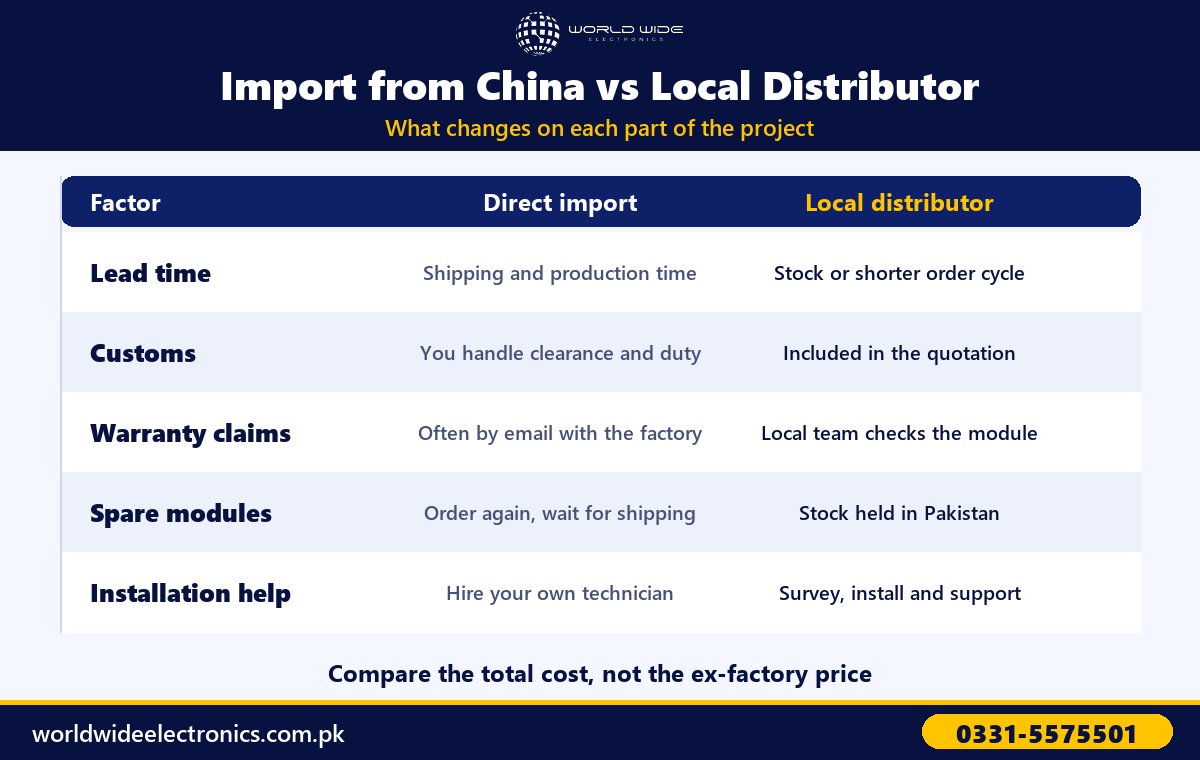
Quick answer: Importing an LED screen from China can lower the ex-factory price, but the saving often shrinks once shipping, customs clearance, warranty claims and spare modules are added. A local distributor is slower to quote on price but usually handles customs, holds spares in Pakistan and sends a technician. Compare the total cost of ownership, not the price on the first quotation.
Many buyers in Pakistan ask whether they can import LED screen from China and save money. The answer depends on the project and the support you need after installation. If you already know the brand, check the LED display brands we distribute and their support terms first. This guide compares the two routes on shipping, customs, warranty, spare parts and installation, which are the points that change the final cost.
What Buying Directly From China Involves
A direct import is more than a purchase order. The buyer, or a clearing agent working for the buyer, usually handles each step below:
- Supplier selection. Checking the factory, the export history and the product certificates. Many factories sell through trading companies, and the name on the invoice may not be the name of the maker.
- Production and packing. The screen is built, tested and packed in cartons, often by cabinet and by module. Packing matters, because damaged modules are a common cause of a dead section on arrival.
- Shipping. Sea freight is cheaper but slow. Air freight is faster and costs more. Both need a clear delivery term, so you know who pays for insurance and who is responsible if the cargo is damaged on the way.
- Customs clearance. The goods are declared, inspected and released at the port. Duties and taxes apply, and the amount depends on how the goods are classified. Ask a licensed clearing agent to confirm the classification and the duty for your specific shipment.
- Delivery to site. The cartons travel from the port to a warehouse or the site, and the screen is unpacked and checked before installation.
Each step adds time and cost, and each one has a point where something can go wrong. A delay at the port can push back an event or a launch date that cannot move.
What a Local Distributor Handles
A local distributor buys the screen in bulk, brings it into the country under its own import process and keeps part of the stock in Pakistan. The price you see is higher on the first quotation, because it includes the cost of that work. What you receive in return is easier to measure:
- Customs is part of the quotation. The distributor carries the clearance risk, so you do not need a separate clearing agent.
- Stock is closer to the job. Some models and pixel pitches are held in Pakistan, which shortens the lead time for an urgent project.
- A named team for claims. A local technician can check a faulty module in person, instead of sending photos to an overseas inbox.
- Installation support. The same team that sells the screen can survey the site, install it and handle the first switch on.
Our installation process guide explains the steps a local team takes from the site survey to the first switch on.
Customs and Shipping: Where the Real Cost Changes
The quotation from a factory is usually for the goods only, at the factory gate. To compare it with a local quotation, you need the landed cost: the goods, the freight, the insurance, the duties and taxes, the clearing charges, the inland transport and the time the money is tied up while the goods are on the water.
Ask for each of these items separately. A quotation that shows only one total makes it hard to see which cost is driving the difference. Also ask who pays if the goods are held at the port, because storage charges can grow every day while the paperwork is checked.
Customs rules and rates change, so do not rely on an old figure from a forum or a friend. Confirm the duty and tax for your product code with a licensed clearing agent before you decide.
Local Warranty: Who Handles a Claim
Warranty is where the two routes differ most. When you import directly, a claim often starts with an email to the factory, followed by photos, a return shipment and a long wait for a replacement module. When you buy from a local distributor, the claim is handled by a team you can call and visit.
Before you choose either route, ask:
- Who issues the warranty, and is the warranty in my name?
- Where is a faulty module tested, and who pays for shipping it back?
- How long does a replacement take to arrive in Pakistan?
- Does the warranty cover the power supply and the receiving card, not only the modules?
Our guide to the SMD screen warranty covers what a warranty normally includes and the exclusions to read before you sign.
Spare Parts Availability: The Cost That Appears Later
A screen will need spare modules at some point. The question is how long you will wait for them. An imported screen usually means a spare order each time, with shipping and clearance added to the price of the module. A screen supplied by a local distributor may have spares in the country, which shortens the downtime.
Ask the supplier for a spare parts list for your model, the number of spare modules they recommend keeping on site, and the price of each module. Then compare how long each route takes to deliver one module to your site.
Genuine Brand Products and Model Matching
Buying a screen with the same brand name on the cabinet does not always mean it is the same product. Components such as drivers, power supplies and receiving cards differ by model and by batch. A mismatch can cause colour differences between cabinets, or a receiving card that cannot control the new modules.
Ask for the model number, the pixel pitch and the component list in writing. Ask whether the product comes with an authorisation letter from the brand. Our Absen LED display guide explains what to check when you buy a branded product for a commercial project.
Common Mistakes When Comparing Two Quotations
Most buyers who regret a decision made the same few errors. Avoid these when you compare offers:
- Comparing different specifications. Check the pixel pitch, brightness and cabinet size on both quotations. A cheaper screen with a coarser pitch may need a much closer viewing distance.
- Ignoring the delivery date. A low price that arrives after the event is not a saving. Put the delivery date and the penalty for delay in writing.
- Forgetting the controller and accessories. Sending cards, power supplies, cables and brackets are sometimes missing from a quotation that shows only the modules.
When both quotations are set out in the same format, the difference is usually easy to see. If one supplier will not itemise the cost, treat that as a warning sign.
Which Route Fits Your Project?
There is no single answer, but the following pattern holds for most buyers:
- A direct import can make sense when the project is large, the timeline is flexible, you have a clearing agent you trust and your team can manage claims and spares from abroad.
- A local distributor usually makes sense when the screen is for a live event, a shop front, a corporate office or any site where downtime costs more than the price difference.
For most businesses that need the screen to work on a fixed date, the lower quotation is not the lower cost. Our guide to top SMD screen suppliers in Karachi lists the questions to ask any supplier, whichever route you choose.
Questions to Ask Any Supplier Before You Pay
- Is the quotation ex-factory, or does it include freight, duties, clearance and delivery to my site?
- Who is the importer of record, and whose name is on the warranty?
- Which spare modules are stocked in Pakistan for my model?
- How long does a replacement module take to arrive?
- Can you show the product certificates and the component list for the model you are quoting?
- Who installs, tests and supports the screen after the switch on?
Related guides: Top SMD Screen Suppliers in Karachi and Why Absen LED Displays Suit Commercial Projects.
Frequently asked questions
Is it cheaper to import an LED screen from China?
The ex-factory price is often lower, but the landed cost includes freight, insurance, duties, clearance, inland transport and the cost of spares and warranty claims. Compare the full landed cost of both quotations before you decide.
Who pays customs when I import an LED screen?
The importer of record pays the duties and taxes, and usually pays a clearing agent as well. If you buy from a local distributor, the customs cost is normally included in the quotation, so check that in writing.
Can I get a warranty on an imported LED screen?
Yes, if the seller issues one, but the claim process matters more than the wording. Ask who handles the claim, where faulty modules are tested and how long a replacement takes to reach your site.
Do local distributors stock spare LED modules?
Some do, for the models they sell most often. Ask for the spare parts list for your model and confirm the stock in writing before you order.