Almost every outdoor display brochure says “IP65”, but very few explain what the number actually protects against, or where it stops. That matters in Pakistan, where one screen may face monsoon downpours, dust storms, coastal humidity and summer heat in the same year. This guide explains what an IP65 LED screen really is, how to read any IP rating, why the front and rear of a cabinet are rated separately, and what to check before you buy. If you are planning a display for a shop front, roadside billboard or building facade, our weatherproof outdoor SMD screens are built to the standards described below, so you can use this as a checklist when comparing any quotation.
What Does IP65 Mean on an LED Screen?
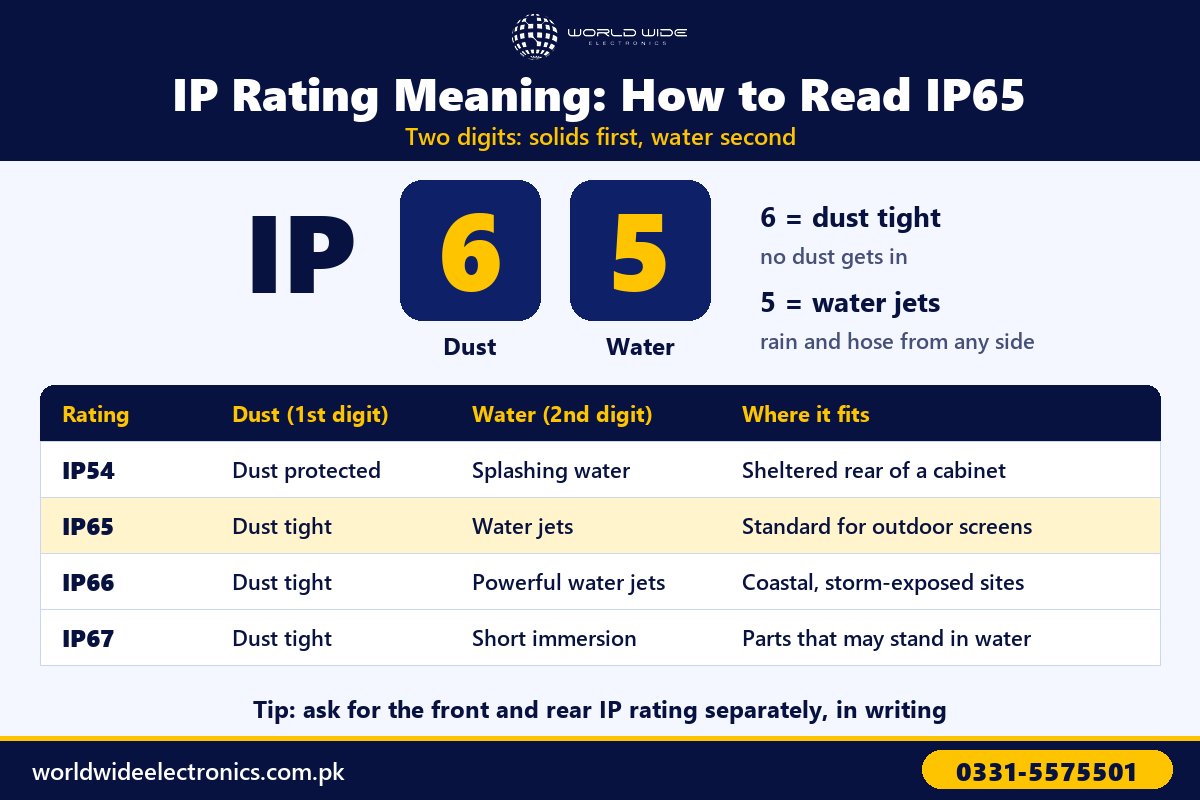
IP stands for Ingress Protection. It is an international standard (IEC 60529) that tests how well an enclosure keeps out solid objects and water. The rating always has two digits, and each digit is tested separately.
- The first digit (0 to 6) is for solids and dust. A 6 means “dust tight”: no dust enters the enclosure during the test.
- The second digit (0 to 9) is for water. A 5 means the enclosure survives water jets sprayed from any direction for several minutes without harmful water getting inside.
So an IP65 LED screen is dust tight and protected against jets of water from any angle. In real life that covers heavy rain, wind-blown rain and gentle cleaning with a hose. It does not mean the screen can be submerged, and it says nothing about heat or sunlight.
IP Rating Meaning: The Ratings You Will See
| Rating | Dust protection | Water protection | Typical use on LED screens |
|---|---|---|---|
| IP20 to IP40 | Large objects only | None | Indoor screens |
| IP54 | Dust protected (a little may enter, not enough to cause harm) | Splashing water | Rear of a cabinet in a sheltered installation |
| IP65 | Dust tight | Water jets from any direction | Standard for outdoor screens |
| IP66 | Dust tight | Powerful water jets | Coastal or very exposed sites |
| IP67 | Dust tight | Temporary immersion up to 1 metre | Individual parts, such as modules or connectors |
A higher second digit is not always “better” for a screen. IP67 tests immersion, not jets, so a part rated IP67 is not automatically rated for powerful spray. Look for the rating that matches the actual risk at your site.
Why IP65 Matters for Outdoor Screens in Pakistan
Water and dust rarely destroy a screen in one day. They work slowly: moisture corrodes connectors and circuit boards, and fine dust settles on power supplies and fans until they overheat. Pakistan’s climate tests both.
- Monsoon rain: heavy, wind-driven rain hits the screen from the side and from below, not only from above. This is exactly the condition the “5” in IP65 is tested for.
- Dust storms and construction dust: in cities such as Lahore, Multan and Quetta, fine dust is the bigger long-term risk. A dust-tight “6” keeps it away from the electronics.
- Coastal humidity: in Karachi and Gwadar, salty, humid air speeds up corrosion. Sealing helps, but coated circuit boards and rust-proof cabinet material matter just as much.
- Heat: summer temperatures can push a cabinet well above 60°C in direct sun. IP65 does not cover heat, so ventilation and heat-tolerant parts are a separate check.
Front and Rear Protection: Why There Are Two Ratings
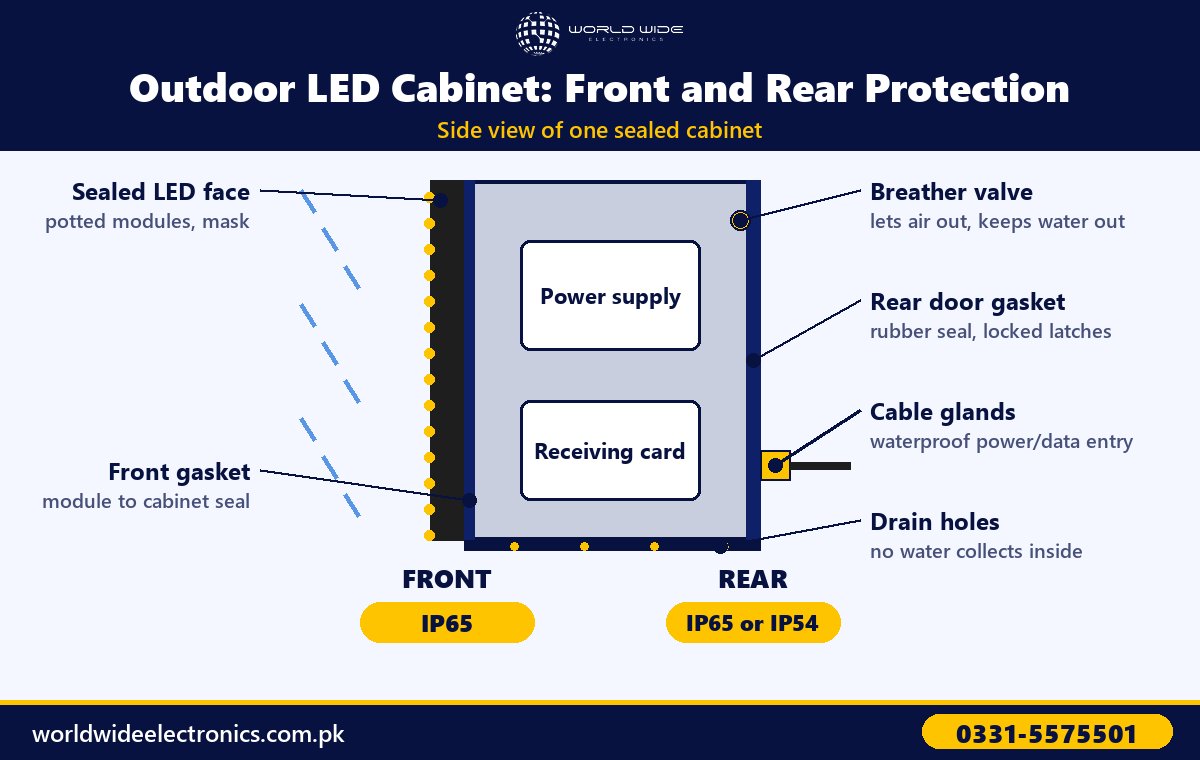
An outdoor LED cabinet has two very different sides, and good suppliers quote front and rear protection separately, for example “IP65 front / IP54 rear” or “IP65 front and rear”.
The front (the LED face)
The front takes direct rain, sun and dust, so it should always be IP65 or better. Protection here comes from the modules themselves: the LEDs and circuit board are sealed with potting glue, a plastic mask covers the face, and a rubber gasket seals each module against the cabinet.
The rear (the cabinet body)
The rear holds the power supplies and receiving cards, the parts most easily damaged by water. How much protection it needs depends on how the screen is installed:
- Rear open to the weather (pole-mounted, rooftop or free-standing screens): ask for IP65 on the rear as well.
- Rear enclosed (screen fixed against a wall or inside a closed steel structure with a roof): IP54 on the rear can be acceptable, because rain cannot reach it directly.
Front-service cabinets, which open from the front for repairs, need careful sealing on the front because that is where they are opened. Rear-service cabinets put more weight on the rear door seals. Either way, the rating only holds if the cabinet is closed and locked correctly after every service visit.
Rain and Dust Protection: What IP65 Covers and What It Does Not
IP65 gives strong rain and dust protection, but it is a lab test on a new, correctly closed enclosure. It helps to know its limits.
| IP65 covers | IP65 does not cover |
|---|---|
| Heavy and wind-blown rain from any direction | Standing water or flooding around the base |
| Fine dust and sand | High-pressure washers used for cleaning |
| Gentle cleaning with a hose | Condensation forming inside the cabinet |
| A new, sealed cabinet | Damaged seals, open doors or poorly fitted cables |
| Rain on the rear, when the rear is also IP65 | Heat, UV fading and lightning or power surges |
Most water damage on outdoor screens comes from the right-hand column, not from rain that “beat” an IP65 seal. Our article 7 Things That Can Damage Your SMD Screen covers the other risks, such as heat, power surges and poor ventilation.
Outdoor LED Cabinet Sealing: What to Check
Two cabinets can both be labelled IP65 and still be built very differently. When you inspect a sample or a spec sheet, look at the details of outdoor LED cabinet sealing:
- Module potting: the back of each module should be filled with waterproof glue, not left as bare circuit board.
- Gaskets: continuous rubber seals around modules and the rear door, with no gaps at the corners.
- Cable glands and waterproof connectors: power and data cables should enter through sealed glands and use waterproof plugs between cabinets.
- Breather valve: a small vent that balances air pressure as the cabinet heats and cools, so moist air is not sucked in past the seals.
- Drain holes: any water that does get in must be able to run out instead of collecting at the bottom.
- Conformal coating: a protective coating on the circuit boards, especially important near the coast.
- Cabinet material: die-cast aluminium or galvanised and painted steel that will not rust at the joints.
- Cooling: fans or air conditioning with filters, placed so they do not create a path for rain.
How to Choose an IP65 LED Screen: Buyer Checklist
- Get the front and rear IP rating in writing, not just “waterproof” or “IP65” on a brochure.
- Ask for a test report from an independent lab for the cabinet and modules you are buying.
- Check that both modules and cabinets are rated. An IP65 module inside a poorly sealed cabinet still lets water reach the power supply.
- Match the rear rating to your installation: exposed rear means IP65; an enclosed rear can be IP54.
- Ask about coastal protection (coated boards, rust-proof frame) if the site is near the sea.
- Read the warranty to see whether water damage is covered and what installation conditions apply.
- Do not judge sealing alone. An outdoor screen also needs enough brightness for direct sun; our guide to outdoor LED screen brightness explains how many nits you need.
If you are still deciding whether your location needs an outdoor screen at all, for example behind a shop window or under a deep canopy, read Indoor vs Outdoor SMD Screens in Pakistan first.
Installation Decides Whether IP65 Works
A perfectly rated cabinet can still take in water if it is installed badly. A few site details make a big difference:
- Keep the bottom of the screen well above ground level and away from where water collects.
- Route cables so they loop downward before entering the cabinet, letting water drip off instead of running into the gland.
- Add a top flashing or canopy over the screen where possible, so water does not pour down the face.
- Leave space behind or in front of the screen for ventilation and service.
- Seal any holes drilled into the structure or wall during installation.
Our SMD screen installation process guide shows where these checks fit into a full project.
Keeping the Protection Working Over the Years
Rubber seals age, especially in strong sun. To keep an IP65 screen sealed:
- Inspect gaskets, glands and rear doors before and after the monsoon.
- Clean the face with a soft brush or low-pressure water, never a pressure washer.
- Make sure every cabinet is fully closed and latched after any repair.
- Replace cracked or flattened gaskets with the correct parts.
- Clear dust from fan filters and drain holes regularly.
Frequently Asked Questions
Is an IP65 LED screen waterproof?
It is weatherproof, not fully waterproof. IP65 means it is protected against rain and water jets from any direction, but it is not designed to be submerged or cleaned with high-pressure washers.
Is IP65 enough for outdoor screens in Pakistan?
For most cities, yes, as long as both the front and an exposed rear are IP65 and the screen is installed correctly. Very exposed coastal sites may justify IP66 and coated electronics.
What is the difference between IP65 and IP66?
Both are dust tight. IP66 is tested against more powerful water jets than IP65, which helps on storm-exposed or coastal sites.
Can I use an indoor LED screen outdoors under a shade?
Not recommended. Indoor screens are usually IP30 to IP40, with no protection against rain, humidity or dust, and they are not bright enough for daylight. Even under a shade, wind-blown rain and dust will reach them.
Get the Right IP65 Screen for Your Site
World Wide Electronics has supplied and installed LED displays across Pakistan since 1999, from shop fronts to large roadside and building screens. Tell us where the screen will go and how it will be mounted, and we will recommend the right front and rear protection for that site. Contact us for a site survey and quotation.