
Outdoor SMD Screen Installation in Lahore: World Wide Electronics & Absen Project
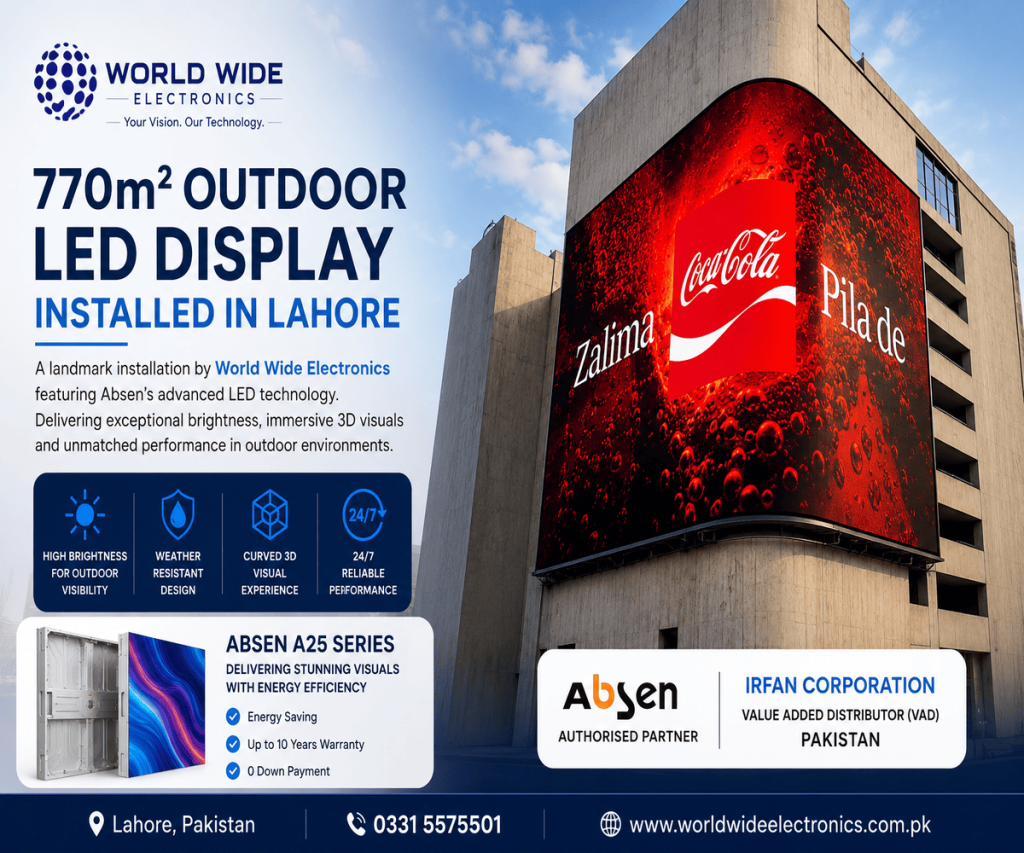
When World Wide Electronics took on the job of installing a large outdoor SMD LED display in Lahore, the goal was simple on paper and demanding in practice: build a screen big enough to command attention on a busy commercial stretch, strong enough to survive Lahore’s weather, and sharp enough to look good from both close range and a distance. The finished installation covers roughly 770 square metres, making it one of the larger outdoor LED display projects completed in the city in recent years. This case study walks through how the project came together, from the reasoning behind the technology choice to the installation itself, and looks at why this particular SMD LED Screen in Pakistan project has become a reference point for what an outdoor SMD LED display can look like when it is planned and executed properly. Lahore has no shortage of outdoor screens, but most are modest in size and built for short-term advertising campaigns. This project was different from the start. The client wanted a display that could function as a long-term visual landmark, not just another billboard replacement, and that requirement shaped nearly every decision that followed, from panel selection to the structural work underneath the screen. Project Overview The project involved designing, supplying, and installing a 770m² outdoor LED display at a commercial site in Lahore. At that scale, the screen is not a single flat panel but a large curved and multi-angled structure, built up from individual LED cabinets fitted together to form a continuous, seamless viewing surface. Getting the geometry right, so that the image reads correctly across every angle of the structure, was one of the more technically involved parts of the build. World Wide Electronics handled the project end to end: initial site assessment, structural planning, sourcing the display panels, coordinating installation crews, and final calibration once the screen was mounted. Because the display sits outdoors and faces direct sun, rain, and Lahore’s dust for most of the year, weatherproofing and brightness control were treated as core requirements rather than optional extras. Why an Outdoor SMD LED Display Was Used Not every LED technology is suited to outdoor use, and this is where the choice of outdoor SMD screens mattered for the project. SMD, short for surface-mounted device, packs the red, green, and blue diodes into a single compact unit rather than mounting them separately. For an outdoor display of this size, that construction offers a few practical advantages. First, SMD panels handle direct sunlight better than older LED formats, which matters a great deal in Lahore where the display faces long hours of harsh daylight for most of the year. Second, they allow for a tighter pixel pitch, which keeps the image sharp even when people are viewing the screen from close range at street level, not just from a distance. Third, SMD technology is generally easier to maintain over a large surface area, since individual modules can be serviced without disturbing the rest of the display. Given the size of this installation and its location on a busy road, durability and image consistency across nearly 770 square metres were non-negotiable. Outdoor SMD was the option that met both requirements without pushing the budget into a range that would have made the project impractical. Absen and the Technology Behind the Display The LED panels used in this installation are manufactured by Absen, a company with a long track record in large-format LED displays, including stadium screens, broadcast studios, and major outdoor advertising installations around the world. For a project of this scale, panel quality and consistency between individual modules are critical, since even small variations in brightness or colour temperature become visible once thousands of modules are combined into one continuous image. The project used Absen LED display technology, while Absen’s official partner directory lists Irfan Corporation as a Value Added Distributor (VAD) for Pakistan and links to World Wide Electronics’ website. This is not a minor detail. It confirms that the panels used in the Lahore installation came through an authorised supply chain rather than grey-market imports, which is a common concern in the outdoor LED market in Pakistan. You can verify this directly through Absen’s official partner directory, which currently shows Irfan Corporation as the recognised VAD for Pakistan and lists worldwideelectronics.com.pk as its associated website. Working with genuine Absen panels, sourced through the correct distribution channel, gave the project access to proper factory warranties, verified specifications, and long-term technical support, all of which matter far more once a screen this size is installed and running for years rather than months. Absen Global Featured the Lahore Installation Beyond the local recognition the project received in Lahore, the installation also caught attention internationally. Absen’s own social media channels featured the Lahore project as an example of the kind of large-scale outdoor work being done with their display technology in South Asia. Absen also featured the Lahore installation on its social media, highlighting the 770m² outdoor LED display and its 3D visual design. The post drew attention to the scale of the structure and how the curved, multi-surface layout was used to create a display that reads as a single cohesive visual rather than a flat screen bolted onto a building. You can view Absen’s social media post featuring the Lahore installation for the original coverage. For World Wide Electronics, having a project of this size acknowledged directly by the panel manufacturer is a useful signal of the quality of the installation work, not just the hardware that went into it. Large LED structures can look impressive in renderings and still fall short once built. This project held up well enough, in finish and in performance, to be highlighted by Absen itself. The Installation Process Physically building a 770m² outdoor LED display is closer to a structural engineering project than a typical electronics installation. The team began with a detailed site survey to understand load-bearing capacity, wind exposure, and the exact geometry the screen would need to